As the U.S. escalates its campaign against Iranian vessels, its choice of destructive weapons—unlike Iran's precision strikes targeting engine rooms while leaving hulls intact —dramatically raises the risk of catastrophic oil spills in one of the world's most fragile marine environments.
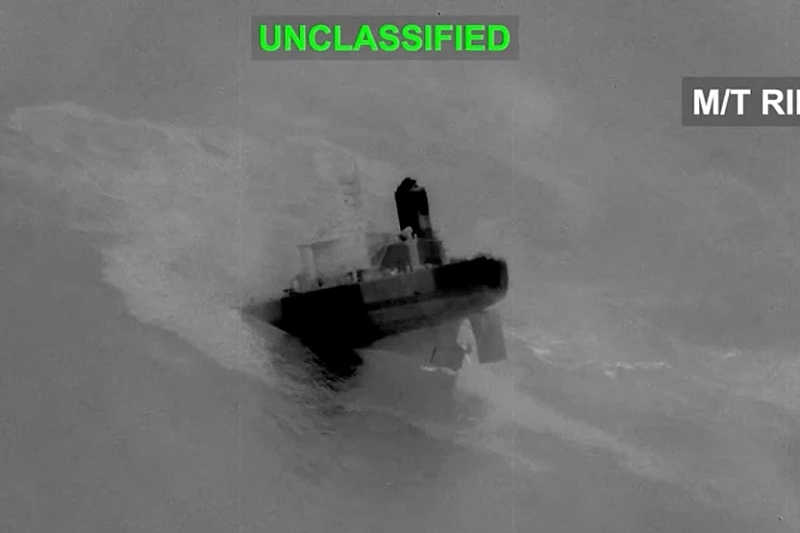
Photo: M/T Riesco sinks in the Gulf of Oman, September 8, after being destroyed by CENTCOM forces in response to attempted IRGC attacks on a US Navy warship. PHOTO: REUTERS
The US war against Iran is increasingly being fought at sea, with both sides targeting oil tankers and other vessels in and around the Strait of Hormuz. But the pattern of attacks could not be more different, and the environmental stakes could not be higher.
On September 8, the United States destroyed five Iranian crude oil carriers . The U.S. Central Command (CENTCOM) said the strikes were retaliation after Iran's Islamic Revolutionary Guard Corps (IRGC) targeted an American Navy warship with ballistic missiles twice over 48 hours . Tehran responded by launching ballistic missiles at a U.S. military base in Jordan and attacking ships in the strait .
CENTCOM released dramatic footage of the attacks, showing Iranian vessels engulfed in flames and sinking . CENTCOM posted videos of the attack on its X account, writing in the caption:
"M/T Riesco sinks in the Gulf of Oman, Sept. 8, after being destroyed by CENTCOM forces"
The images reveal what analysts have long feared: the U.S. is using high-destructive weapons aimed at destroying entire tankers, not merely disabling them. "Thanks to the precision and professionalism of American service members, the M/T Kylo sank in the Gulf of Oman today and joined Iran's navy at the bottom of the sea," CENTCOM posted on social media .
A deadly difference in tactics
Iran's approach stands in stark contrast. According to
The New York Times, "Iran's attacks don't destroy tankers, but some do enough damage that the ships are out of action while they are repaired." Iranian forces appear to be targeting engine rooms with precision weapons, leaving ships adrift but largely intact—a calculated strategy to avoid oil spills and widespread pollution.
One shipping executive, speaking on condition of anonymity, described it simply: "Iran appeared to be targeting the engine rooms of ships, leaving them at risk of becoming stranded."
The U.S. approach is far more reckless. Targeting the hull of an oil tanker with a high-explosive weapon risks catastrophic environmental damage. Modern tankers have double hulls designed to prevent spills from surface damage, but uncontrolled explosions can easily penetrate both layers and rupture cargo tanks—releasing millions of barrels of crude directly into the sea.
A toxic time bomb
The September 8 attacks illustrated the danger. One Iranian tanker, the M/T Derya, was struck just four miles offshore near Kharg Island, Iran's main oil export hub . The proximity to land dramatically increases the risk of grounding and coastal contamination.
At any given moment, the Gulf holds a staggering volume of oil at risk. As of September 7, MarineTraffic data showed 42 tankers waiting to pass through the Strait of Hormuz, including 18 oil tankers carrying an estimated 1.76 million cubic meters of petroleum—roughly 11.1 million barrels, or 11 percent of global daily demand. That is enough oil to fill 714 Olympic swimming pools, according to
Al Jazeera.
A fragile ecosystem already under siege
The Persian Gulf is uniquely vulnerable. With limited water exchange with the Indian Ocean, pollutants accumulate and persist for years. Iran's foreign ministry has already blamed U.S. military operations for Gulf pollution, estimating the damage at "trillions of dollars" . An oil slick from a tanker damaged by explosions recently reached Qeshm Island's environmentally sensitive mangrove forests .
Yet the escalation continues. On September 5, U.S. forces destroyed three Iranian crude carriers . U.S. Secretary of State Marco Rubio warned that "for every time they do that or try to do that they're going to lose tankers" . War Secretary Pete Hegseth was blunter: "Iran's oil tanker fleet is defenceless — Iran has no navy or air force. Our planes, ships & subs can strike them all" .
The cost of recklessness
Each uncontrolled strike on a tanker risks a spill that could devastate marine life, coastal communities, and the region's fisheries for generations. Iran's precision approach—targeting engine rooms while leaving hulls intact—suggests an awareness of this risk. The U.S. appears to be ignoring it.
As oil tankers continue to be targeted, one thing is clear: the ecological damage from this conflict will outlast any ceasefire.










Comment
Reply