


21 Nov 2026
Tired Earth
By The Editorial Board
The Human Rights Foundation (HRF) has strongly condemned the candidacy of Lana Nusseibeh, the United Arab Emirates’ nominee for United Nations Secretary-General, arguing that her record of denying and concealing evidence of Abu Dhabi’s role in Sudan’s war disqualifies her from the position.
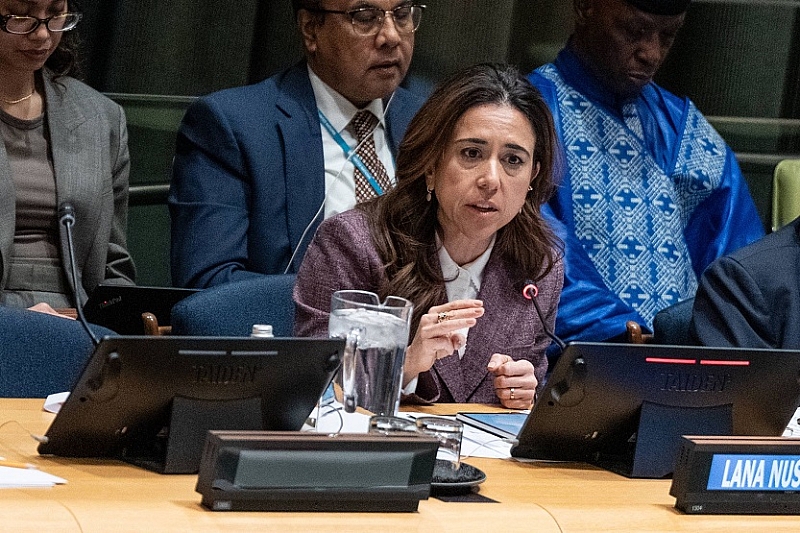
In statements published on 5 November, HRF described Nusseibeh as “not only the soft face of a brutal dictatorship” and pointed to what it called her repeated refusals to address “incontrovertible evidence” that the UAE has armed and financed the Rapid Support Forces (RSF), the paramilitary group that UN investigators have implicated in genocidal violence. The organisation also accused the UAE government of allowing RSF figures, family members, and sanctioned individuals and entities linked to the group to hold “ill-gotten wealth” within Emirati territory.
The UN Findings at the Centre of the Dispute
The HRF’s intervention rests on a body of UN documentation that has accumulated over more than two years. A UN fact-finding mission concluded that the RSF’s assault on El Fasher, the capital of North Darfur, “bore the hallmarks of genocide”. A separate UN panel of experts found “credible allegations” that the UAE was providing military support to the RSF through Chad as early as 2024.
More recently, a confidential report submitted to the Security Council in November 2026 and obtained by The New York Times detailed how an Emirati security company with close ties to the government moved Colombian mercenaries into Sudan through territory controlled by Emirati proxies in Libya and Somalia. The report described the UAE as accused of supplying drones, weapons, and mercenaries to the RSF, fuelling a conflict that has caused hundreds of thousands of deaths.
Nusseibeh has consistently rejected these findings. In a September 2024 letter to The Economist, she wrote that “the UAE is not providing weapons or any other support to the Rapid Support Forces or any of the warring parties in Sudan”. She has maintained that position throughout her candidacy.
A Broader Coalition of Criticism
The HRF is not alone. Human Rights Watch (HRW) has accused Nusseibeh of an “extensive record of denying and whitewashing” abuses in Sudan and Yemen, with HRW’s chief advocacy officer Bruno Stagno Ugarte stating that her “disinformation” has “seriously undermined justice and accountability for the victims”.
Kenneth Roth, former executive director of Human Rights Watch, told a webinar organised by Avaaz that Nusseibeh’s repeated denial of the UAE’s role was unacceptable: “She has been asked about the UAE’s role in arming and supporting the RSF, and she just blatantly denies it without regard to the facts — that is not what we need as UN Secretary-General”.
Refugees International has called for a “no” vote on her candidacy, stating that if Nusseibeh “cannot speak out on the role of the UAE in Sudan and her own role in denying UAE support for a genocidal militia, she must be rejected”.
In the UK Parliament, an Early Day Motion signed by MPs opposes her candidacy, citing her “rejection of UN experts’ published findings concerning UAE support for Sudan’s Rapid Support Forces” and urging the British government to use its Security Council veto if necessary. A group of 67 British lawmakers has also called on the government to block her bid.
The Stakes for the UN
The controversy comes at a delicate moment for the United Nations. The Security Council has struggled for months to agree on a successor to Secretary-General António Guterres, whose term ends on 31 December. Nusseibeh’s late entry in October upended a race that had already failed to produce a consensus candidate. So far, she has not received any opposing votes from the council’s five veto-wielding members.
For the HRF and the broader coalition opposing her, the question is not simply whether Nusseibeh would be independent, but whether the UN’s credibility on atrocity prevention can survive the appointment of a candidate who has spent years denying the evidence of her own government’s complicity. As HRF put it, entrusting the UN’s highest office to a representative of a “fully authoritarian regime” stands in “stark contradiction to the principles and values” of the organisation.
Plastic Pollution in Cameroon and Africa Plastic Pollution in Cameroon and Africa

The best of Tired Earth delivered to your inbox
Sign up for more inspiring photos, stories, and special offers from Tired Earth
By signing up for this email, you are agreeing to news, offers, and information from Tired Earth. Click here to visit our Privacy Policy.




Comment
Reply