

11 Jun 2026

Sarah Rahman
A president who announces colonial seizure as policy, who celebrates the destruction of a nation's defenses as prologue to looting its resources, who invokes Venezuela as a model of mutual benefit — this is not business as usual. It is a declaration of where the post-liberal international order ends and something far older and darker begins.

On June 11, 2026, President Donald Trump did not issue a diplomatic communiqué, did not convene an emergency session of the UN Security Council, and did not consult with allies. He posted on Truth Social. In fewer than a hundred words, he announced renewed bombardment of a sovereign nation, threatened the permanent seizure of its principal economic artery, and compared his imperial ambitions to his management of Venezuela — all with the casual tone of a man announcing a golf score.
The post is not merely a provocation. It is a confession. It lays bare, with unprecedented clarity, an ideology of raw resource conquest that the United States has long pursued in shadows but rarely proclaimed from the presidential pulpit. The mask has not slipped — it has been thrown away deliberately, replaced by a crown.
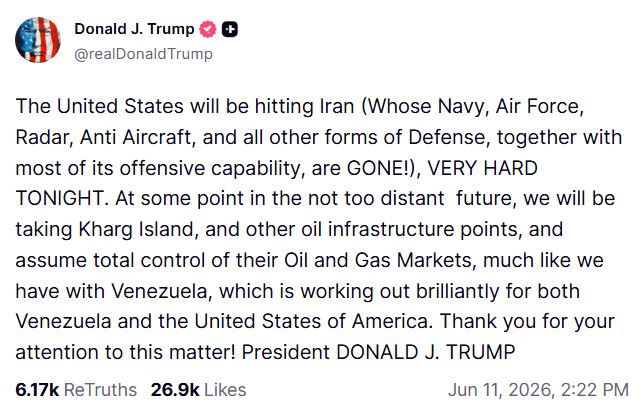
Let us be precise about what is being proposed. Kharg Island is not a military installation. It is the terminal through which approximately 90% of Iran's crude oil exports flow — the economic lung of a nation of 90 million people, worth an estimated $53 billion annually, roughly 11% of Iran's GDP. Trump has not merely threatened to strike military targets there; he has announced the intention to "assume total control" of Iran's oil and gas markets, framing permanent occupation of foreign energy infrastructure as a natural extension of American foreign policy.
This is not a legal grey area. The UN Charter, to which the United States remains a signatory, prohibits the threat or use of force against the territorial integrity of any state. The seizure of another country's natural resources constitutes a fundamental violation of the principle of permanent sovereignty over natural resources, enshrined in UN General Assembly Resolution 1803 since 1962. The Rome Statute identifies the deliberate destruction of civilian economic infrastructure as a potential war crime. What Trump described is not a counter-terrorism operation or a measured response to provocation. It is annexation by another name.
What makes the post particularly alarming is not its novelty but its normalization. Since Operation Epic Fury was launched on February 28, 2026, the U.S. has already struck dozens of targets on Kharg Island, dismantled Iran's air and naval defenses, and closed off diplomatic off-ramps with escalating ultimatums. Each step has been presented as a response to Iranian provocation, yet the destination — control of Iran's oil — has been the destination all along. Today's Truth Social post simply removes the pretense.
The architecture built after 1945 — the UN Charter, the Geneva Conventions, the Non-Proliferation Treaty — was imperfect and selectively applied. But it existed. What replaces it, when the world's most powerful military announces sovereign resource seizure via social media, is not a new order. It is the absence of order. It is, precisely as the post's critics have noted, the law of the jungle.
Trump's comparison to Venezuela is worth lingering on. He claims that American control of Venezuela's oil markets is "working out brilliantly for both Venezuela and the United States." This is an astonishing revision of reality. Venezuela, once the wealthiest nation in Latin America, has seen its oil sector gutted through a combination of sanctions, forced sales, and external management that has left ordinary Venezuelans without reliable electricity, food security, or economic sovereignty. If this is the model being offered to Iran, it is not generosity — it is a blueprint for permanent subordination dressed as mutual benefit.
The ideological core of Trumpism has always contained this strand: that American military and economic supremacy entitles Washington to treat the natural resources of weaker states as a kind of global commons under American management. It is colonialism without the flag-planting, imperialism with a stock market ticker attached. The Venezuela precedent, however partial its implementation, now functions as a proof-of-concept to be applied to a far more strategically significant prize.
Kharg Island handles oil destined primarily for China and Asian markets. Controlling it does not merely enrich America — it places Washington's hand on the jugular of competing powers' energy supply. This is not about Iran. It never was entirely about Iran. It is about who controls the flow of energy in the 21st century, and it is being decided by bombardment rather than diplomacy.
The great oil companies, the commodity traders, the financial institutions that will manage the "assumed control" of Iranian markets — they are the silent beneficiaries of every Truth Social post that precedes a bombing run. The merger of military power and corporate interest has a long history. What is new is the brazenness.
When the United States and Israel launched Operation Epic Fury in late February 2026, European allies were reportedly informed just minutes before the strikes began. Germany's Chancellor Merz, leading the EU's largest economy, received word only moments in advance. This was not an oversight. It was a statement about what Washington thinks of European consultation.
Europe's response since then has been a masterclass in calibrated cowardice. The leaders of Germany, France, and the United Kingdom issued a letter urging de-escalation. France called for emergency UN Security Council discussions. The EU expressed concern about international law. And then, with admirable consistency, they did nothing consequential. NATO's Secretary General praised the strikes and declared that there was "no sliver of light" between the allies and Washington. Europe's most powerful institution became a megaphone for a war it had not endorsed, not authorized, and not been consulted about.
The pattern is now familiar. Europe protests at the margins, issues carefully worded communiqués, and then accommodates itself to facts on the ground. It did so with the unilateral withdrawal from the JCPOA in 2018. It did so with the assassination of Qasem Soleimani. It is doing so now, as Trump announces the seizure of a sovereign nation's oil infrastructure with the nonchalance of a corporate acquisition. Europe speaks of rules-based order at conferences and then quietly funds, hosts, and operationally supports the forces dismantling it.
This is not merely hypocrisy — it is a structural failure. Europe has outsourced its security to a partner that no longer pretends to share its values. The continent that built the International Criminal Court, that championed the JCPOA, that lectures the Global South on governance and sovereignty, watches in near-silence as a sitting American president announces colonial resource seizure on social media. The silence is not neutral. It is complicit. History will not distinguish between those who committed the act and those who applauded, accommodated, or simply looked away.
For years, Western foreign ministries treated "multipolarity" as either an academic abstraction or a form of adversarial propaganda — something Russia and China invoked to justify their own transgressions. The Iran conflict has made that dismissal untenable.
The closure of the Strait of Hormuz — through which roughly one-fifth of the world's oil supply passes — has accelerated what analysts were already calling "fragmented globalization." Supply chains are being restructured along political fault lines. Beijing and Moscow are advancing their own economic architectures through the Shanghai Cooperation Organization and BRICS. The disruption of Iranian oil has pushed Asian economies to deepen their investment in alternative trade corridors. The petrodollar's dominance over energy transactions is being contested with renewed urgency.
Multiple power centers — China, India, Brazil, the Gulf states — are navigating this conflict not as passive observers but as strategic actors with their own interests in the post-conflict order. India has not condemned the American strikes; neither has it endorsed them. It is doing what middle powers do in a multipolar world: maximizing optionality. Brazil, under Lula, has called for negotiations while deepening BRICS economic ties. China has watched the destruction of Iran's military capacity with the sobriety of a state recalculating long-term regional positioning.
BRICS has not, it is true, mounted a unified defense of Iran — an embarrassing gap for a grouping whose credibility rests on being an alternative to Western hegemony. But the absence of BRICS solidarity does not mean the absence of multipolarity. It means multipolarity is complicated, contested, and under construction — which is precisely what a world in transition looks like. The question is not whether multiple power centers exist; they do. The question is whether they can forge institutions capable of constraining even the most powerful among them. That work is urgent, and it is happening whether Western chancelleries acknowledge it or not.
What the 2026 Iran conflict has demonstrated, above all, is that the United States can no longer impose its will at zero diplomatic cost. The Strait of Hormuz closure has rattled global energy markets and driven Brent crude toward triple digits. The ECB has raised rates three times this year partly in response to Middle East risk premiums. American unilateralism is no longer costless — not for the world, and increasingly not for Washington itself.
Let us call today's Truth Social post what it is: a coronation speech. Not the crowning of a king over a people, but the self-anointing of a government over a commodity — oil — that the 21st century still runs on.
The logic is transparent. Iran's military capacity has been, as Trump boasts with a certain relish, largely destroyed. Its navy, air force, radar, and anti-aircraft systems are degraded or gone. A nation of 90 million, its defenses stripped, its supreme leader assassinated, its economy under maximum pressure, is now being told that its principal remaining source of national wealth — the oil flowing through Kharg Island — will be "assumed" by Washington. This is not deterrence. This is not counter-proliferation. This is extraction.
The invocation of Venezuela as a success story completes the picture. A model where American power installs a compliant framework over a nation's oil sector, declares it mutually beneficial, and moves on — this is the future being proposed for Iran. It is not development. It is not partnership. It is the old imperialism dressed in the language of market management.
And the audience for this post is not the Iranian government. It is not the UN. It is the American domestic base that finds in foreign subjugation a compensatory pride — the pleasure of empire narrated in real time, on a social media platform, before breakfast. It is, in every meaningful sense, a spectacle of power designed to be consumed, shared, and celebrated by those who will never see the smoking craters on Kharg Island or the economic devastation in the streets of Tehran.
Trump's Truth Social post is a symptom, not a cause. The cause is a longer crisis of the international order — one in which the rules have been selectively applied for decades, in which powerful states have always enjoyed impunity, and in which the institutions designed to constrain force have been systematically weakened. Trump did not create this crisis. He is its most unfiltered expression.
But expressions matter. Words matter. A president who announces colonial seizure as policy, who celebrates the destruction of a nation's defenses as prologue to looting its resources, who invokes Venezuela as a model of mutual benefit — this is not business as usual. It is a declaration of where the post-liberal international order ends and something far older and darker begins.
Europe must choose. Not between Washington and Tehran, but between values it claims and values it enacts. The Global South, long the object of Western lectures on governance, is watching with an attentiveness that will shape alignments for decades. The multipolar world will not be built by proclamation — it will be built by the accumulation of choices made in moments exactly like this one.
History is being written today, in real time, 280 characters at a time. The question is who will be judged to have read it — and who will be judged to have looked away.

The best of Tired Earth delivered to your inbox
Sign up for more inspiring photos, stories, and special offers from Tired Earth
By signing up for this email, you are agreeing to news, offers, and information from Tired Earth. Click here to visit our Privacy Policy.


Comment
Reply