



13 Oct 2026

Tired Earth
By The Editorial Board
Food is not merely something placed on a table. In societies that stand firm in the face of occupation, it is a part of collective memory, culture, and identity—recipes passed down from generation to generation, telling the story of the places and peoples who cooked them.
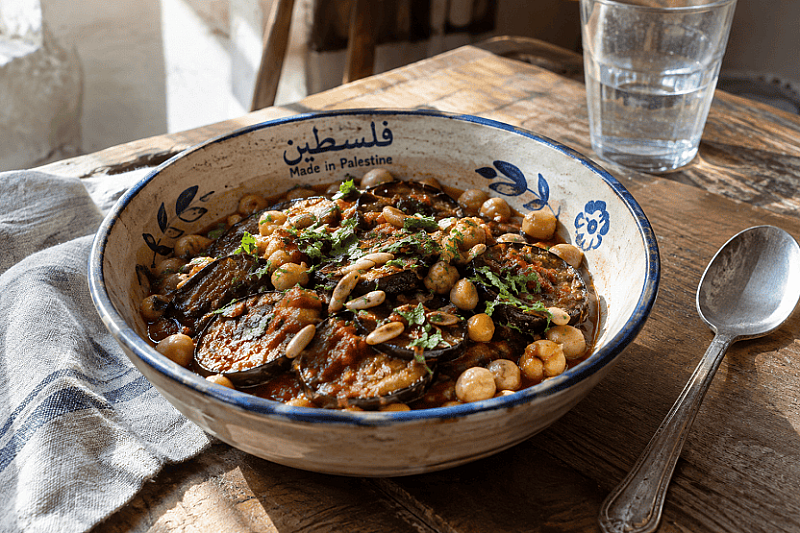
Food is not merely something placed on a table. In societies that stand firm in the face of occupation, it is a part of collective memory, culture, and identity—recipes passed down from generation to generation, telling the story of the places and peoples who cooked them.
This may be why even a simple dish—Mnazaleh—can become a battlefield: on one side the occupier, on the other a people whose land, and now whose table, have become targets of dispossession.
Rima Hassan recently wrote that when she cooked Mnazaleh—a Palestinian dish—she discovered that several Israeli websites presented it as an "Israeli dish." She called the claim a "joke." But this "joke" is part of a systemic enterprise carried out for decades.
The Israel Forever Foundation published a Mnazaleh recipe under the title "Mnazaleh – Eggplant and Chickpeas in Tomato Sauce" in its culinary section, placing it within the framework of "Israeli cuisine." On the other side, the website Arab America explicitly presents it as "Palestinian M'Nazaleh." But the problem goes far beyond one website or one recipe.
A Systemic Enterprise, Not Scattered Claims
The dispossession of Palestinian cuisine follows the same logic as that which swallows land and displaces populations. Palestinian writer and professor emeritus of Arabic and comparative literature at the University of Michigan, Anton Shammas, named this phenomenon in his classic essay "Falafel, Cultural Cannibalism, and the Poetics of Palestinian Space," first presented at the annual meeting of the Middle East Studies Association in 1996.
Shammas demonstrates how hummus and falafel, markers of Palestinian cuisine, were transformed into Israeli "national snacks" through myth-making, marketing, and the systematic erasure of the word "Palestinian." He cites in particular a booklet published by the Israeli embassy in Washington in the mid-1990s, titled "Beyond Milk and Honey: Traditional Recipes from an Israeli Kitchen," in which tahina is defined as "a typical Oriental dish brought to Israel by Jewish refugees from Arab countries," hummus as "like tehina, hummus was brought to Israel from Arab countries," and falafel as "sold at street corners in every city and village in Israel"—the word "Palestinian" not appearing once in the entire booklet.
Shammas defines this cultural appropriation as a form of "colonial mimicry," drawing on the theoretical frameworks of Homi Bhabha, Derrida, and Walter Benjamin, to reveal how dispossession, imitation, and survival intertwine in the landscape of occupied space.
Researchers Ronald Ranta and Yonatan Mendel of King's College London have systematically demonstrated in their article "Consuming Palestine: The Israeli-Palestinian Conflict in Israeli Food Culture" (2014) that Israeli culinary culture "needs" Arab-Palestinian culture as a source of imitation and indigenization, while seeking to "de-Palestinianize" it. The early Zionists maintained a relationship with Palestinian Arabs and their culture mixed with romanticism, admiration, and imitation; but as the Zionist objective turned toward creating an independent political and economic society to replace the Palestinian Arab people, this process of contact transformed into substitution, appropriation, and deliberate forgetting and rewriting of the past.
The Hummus Wars: From the Kitchen to the Guinness Record
In 2008, the Association of Lebanese Industrialists attempted to register hummus as an exclusively Lebanese product with the European Union. The argument was as follows: "The word hummus in Arabic means chickpeas. So this name comes from Arabic." In response, Israel manufactured the largest plate of hummus in the world. Lebanon retaliated with an even larger plate. These "hummus wars" became a media competition. But behind this laughable spectacle lay a bitter reality: Israeli companies like Osem and Strauss were exporting ready-to-eat hummus and falafel mix to European supermarkets, under the label "traditional Israeli snack."
What is unique about the hummus war is that it is not a debate about the right recipe, authenticity, or terroir, but a bare question of ownership and power. The central issue is the appropriation of the other's food—more precisely, the enemy's food.
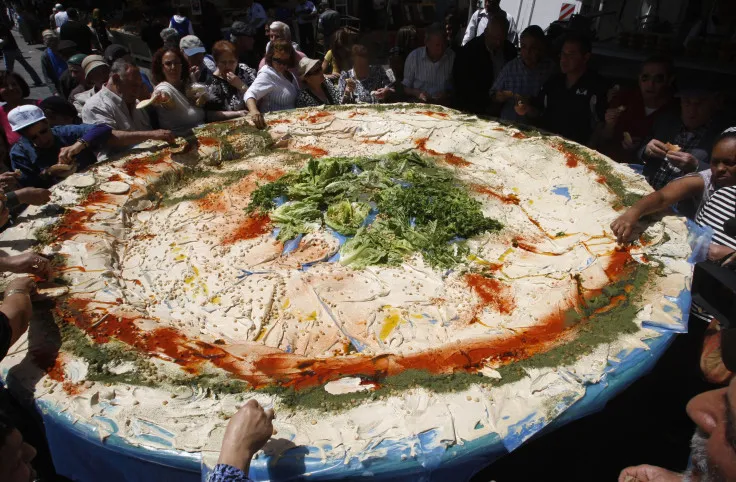
In 2008, Israel displayed 400 kilograms of hummus in a dish 4 meters in diameter at the Mahaneh Yehuda market in Jerusalem
Food as a Tool of Cultural Cleansing
Researchers at King's College London have shown that the "Israelization" of Palestinian cuisine is a conscious project: the remarketing of Palestinian dishes under an Israeli name is part of a broader approach that denies the rights and very existence of Palestinians. Ronald Ranta, professor of politics and international relations, says on this subject: "To accept Palestinian food, or to acknowledge Palestinian influence in cuisine, is to accept the Palestinian people, Palestinian rights, and a future Palestinian state; and that is why many Israelis cannot say it."
This analysis places the conflict around Mnazaleh in its true framework. The question is not "who cooked this dish first"—the question is that a colonial project, in order to construct an "indigenous" identity for itself, is compelled to devour and appropriate the culture of the natives it expels.
The Table, the Last Bastion
Palestinian chef Sami Tamimi—author of the celebrated cookbook Falastin—says in an interview: "For many Palestinians around the world, cooking is in itself an act of preservation. Every time we prepare a traditional dish, we keep something alive—whether it is a family memory, a regional specialty, or the communal act of sharing a meal. It is one of the most universal ways of expressing care and connection. Through food, we say: this is who we are, and where we come from."
Tamimi adds: "But also, as a Palestinian, I think people were in such a state of shock at what happened that food was part of their preservation, but they did not think they needed to protect it and put it forward."
The debate around Mnazaleh, hummus, or falafel is not a debate about "taste." It is a debate about the existential truth of a people. When a colonial enterprise not only takes the land, not only displaces populations, but registers in its own name their cuisine, their clothing, and their cultural symbols, what is at stake is not a "cultural exchange." It is a dispossession of identity in the service of cultural cleansing.
And the table—the only thing a people in exile can carry with them—becomes a battlefield.

The best of Tired Earth delivered to your inbox
Sign up for more inspiring photos, stories, and special offers from Tired Earth
By signing up for this email, you are agreeing to news, offers, and information from Tired Earth. Click here to visit our Privacy Policy.



Comment
Reply