



22 Apr 2026

Tired Earth
By The Editorial Board
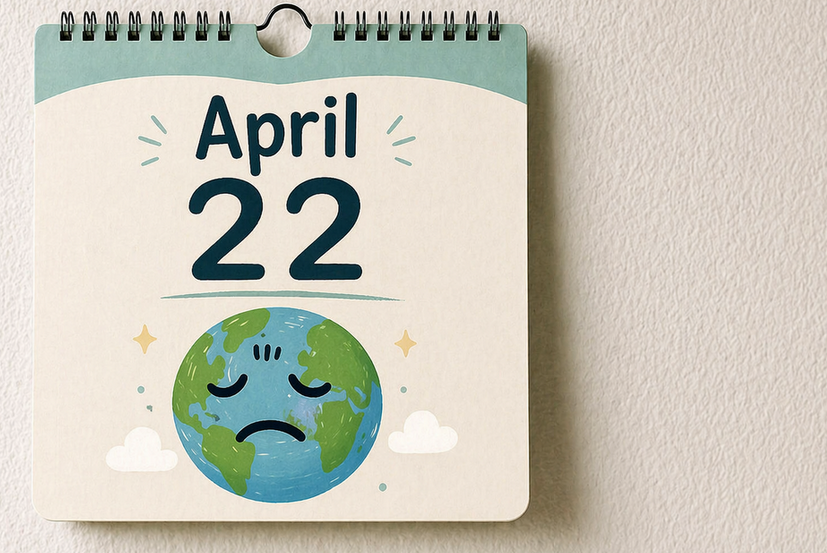
Today, April 22, is Earth Day. But in 2026, it arrives under a shadow that feels impossible to ignore: a world increasingly shaped not only by climate change—but by war.
This year, the environmental movement faces an uncomfortable truth. While governments speak of “green transitions” and “net-zero targets,” many of those same powers are simultaneously engaged in conflicts that are accelerating ecological destruction on a massive scale. From Gaza to Sudan, from Ukraine to Iran, war is not just a humanitarian catastrophe—it is an environmental one.
Yet it remains largely absent from global climate conversations.
One of the least discussed facts is that modern warfare is deeply carbon-intensive.
Early estimates suggest that just the first two weeks of the 2026 Iran war generated more than 5 million metric tons of CO₂ equivalent emissions—roughly more than the annual emissions of entire small countries .
And that is only the beginning.
Bombing campaigns, burning oil infrastructure, military logistics, and reconstruction efforts all contribute to emissions that are rarely counted in national climate targets. Unlike industries, war emissions are often excluded from international climate accounting frameworks, making them effectively invisible.
This raises a critical question for Earth Day:
How can the world claim to fight climate change while simultaneously fueling one of its most intense accelerators?
The 2026 conflict involving Iran has already triggered what analysts describe as the largest energy supply disruption in modern history, cutting more than 12 million barrels of oil per day—over 11% of global demand .
But the environmental consequences go far beyond energy.
Experts warn that such pollution could persist for decades, affecting human health, agriculture, and biodiversity.
War, in this sense, is not just destruction—it is long-term ecological poisoning.
At the same time, the ripple effects are being felt far from conflict zones, particularly across global food systems. Key trade routes such as the Strait of Hormuz—vital not only for oil but also for fertilizers—have faced repeated disruptions. With a significant share of the world’s urea fertilizer passing through this corridor, supply constraints have driven sharp price increases and strained agricultural production worldwide. Farmers in multiple regions are already scaling back fertilizer use, raising concerns about declining yields of staple crops such as wheat, rice, and maize.
These pressures are not isolated. They feed into a broader cycle in which conflict disrupts energy and agricultural markets, prompting greater reliance on fossil fuels and intensifying emissions. As climate instability grows, so too does competition over resources, increasing the risk of further conflict. Experts warn that this feedback loop—linking war, resource scarcity, and environmental stress—is becoming one of the defining challenges of our time.
This year’s Earth Day theme, “Our Power, Our Planet,” emphasizes collective responsibility. That message matters—but it is incomplete.
Individual action—recycling, reducing waste, conserving energy—is important. But it cannot offset the environmental damage caused by large-scale military conflicts and geopolitical decisions.
If Earth Day is to remain meaningful, it must confront a difficult reality:
You cannot claim to protect the planet while supporting systems that destroy it at scale.
Despite fantasies of escape—whether bunkers or distant planets—Earth remains humanity’s only home.
And today, that home is being damaged not only by neglect, but by deliberate decisions.
Earth Day 2026 should not just be a celebration.
It should be a confrontation.
A reminder that protecting the environment is not only about changing how we live—
but about challenging the systems that are destroying it.

The best of Tired Earth delivered to your inbox
Sign up for more inspiring photos, stories, and special offers from Tired Earth
By signing up for this email, you are agreeing to news, offers, and information from Tired Earth. Click here to visit our Privacy Policy.


Comment
Reply