



27 Apr 2026

Tired Earth
By The Editorial Board
The escalation of the conflict involving the United States, Israel, and Iran has triggered a shockwave that extends far beyond geopolitics. From devastating oil spills and skyrocketing industrial raw material prices to strategic blockades in the Strait of Hormuz, this war of attrition is now threatening global food security and forcing an ecological mutation within the agricultural sector.
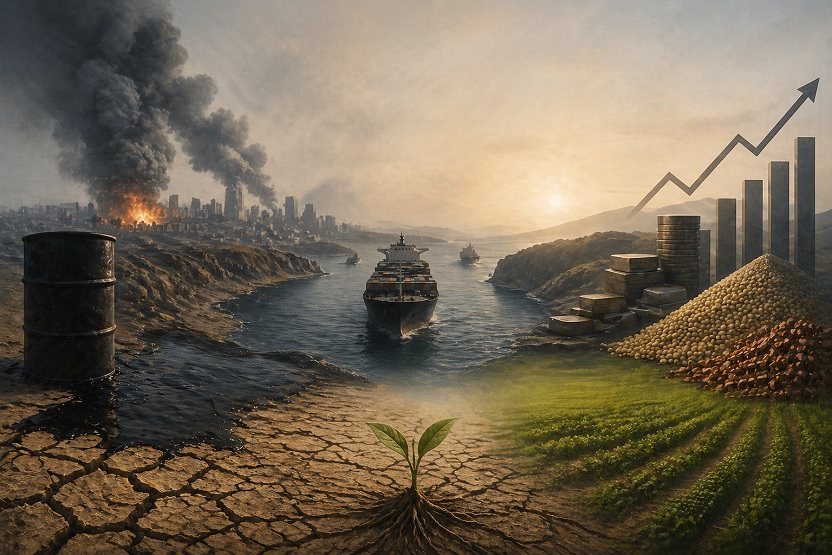
Environment Sacrificed: The Catastrophe of the "Black Snake"
On the ground, the direct ecological consequences of the conflict have reached critical levels. Strikes on oil infrastructure and tankers have caused massive pollution visible from space.
As reported by Futura-Sciences, recent satellite imagery reveals what experts call a "black snake"—a trail of crude oil stretching hundreds of kilometers. This toxic slick "tells the story of what the war in Iran is already leaving behind: it is a catastrophe." This major ecological disaster for the Persian Gulf’s marine biodiversity is rendering coastlines uninhabitable for local wildlife and destroying coastal ecosystems for decades to come.
Global Economy: Inflation and Shortages of Critical Materials
The conflict is weighing heavily on global macroeconomic indicators. Paralysis of maritime routes and energy uncertainty are fueling inflation that hits key sectors.
Energy and Transport: According to Franceinfo, the "war of attrition in the Middle East is already weighing on the economy," particularly affecting oil barrel prices and the aviation sector, which is forced to bypass vast aerial exclusion zones.
Industrial Raw Materials: The impact is even more pronounced on essential chemical components. L'Usine Nouvelle points out that prices for sulfur and sulfuric acid are "exploding." These elements are nonetheless "essential for fertilizers and mines," creating immediate tension across the entire global industrial and agricultural production chain.
Agriculture: The Hormuz Blockade Forces an Ecological Transition
The blockade of the Strait of Hormuz, a vital chokepoint, has cut off traditional supply routes for synthetic fertilizers. This situation has left farmers, particularly in Europe, in an economic dead end.
Faced with this "fertilizer crisis linked to the Hormuz blockade," producers have no choice but to overhaul their production models. However, this constraint is generating unexpected effects. The Huffington Post observes that "more ecological solutions are sprouting among farmers."
A Forced Mutation Toward Nitrogen Sobriety
To compensate for the absence of imported chemical fertilizers, new practices are emerging:
Increased use of legumes to fix nitrogen naturally in the soil.
The development of local bio-fertilizers derived from the circular economy.
Accelerated investment in precision agriculture to reduce application doses.
While the situation is critical for immediate farm profitability, it could act as a catalyst for food sovereignty that is less dependent on fossil fuels and distant imports.
A Global Outlook Under High Tension
The convergence of these environmental, industrial, and agricultural crises paints an uncertain future. Between the irreparable pollution of Gulf waters and the destabilization of food markets, the real cost of this war of attrition could be measured in lost global GDP points and irreversible degradation of the biosphere. The resilience of farmers in the face of fertilizer shortages remains, for now, one of the few levers of adaptation in a devastated geopolitical landscape.
Source : News agencies

The best of Tired Earth delivered to your inbox
Sign up for more inspiring photos, stories, and special offers from Tired Earth
By signing up for this email, you are agreeing to news, offers, and information from Tired Earth. Click here to visit our Privacy Policy.



Comment