At first glance, they are just mountains of shattered concrete, twisted scrap metal, and grey dust. But beneath the rubble of the war that devastated Lebanon, a silent catastrophe is brewing — one that will not end with a ceasefire.
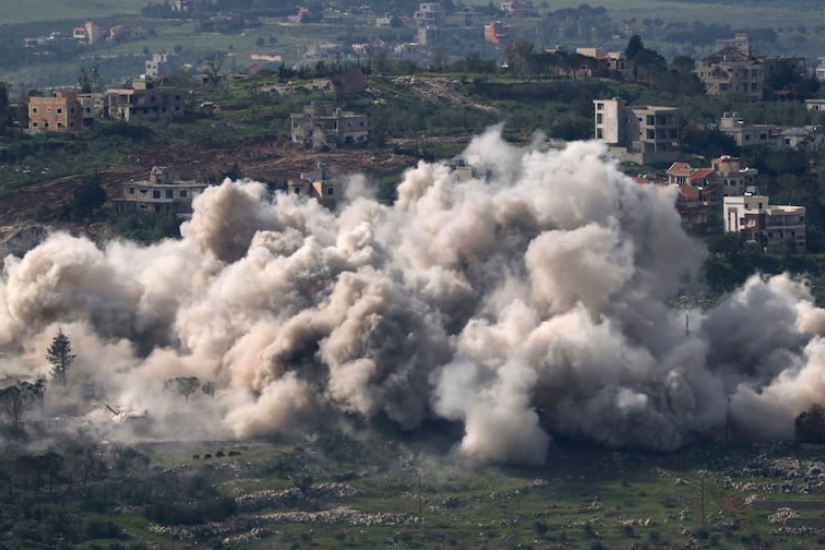
Israeli military demolition operations in the village of Taybeh, in southern Lebanon, on April 27
According to the latest United Nations estimates, the conflict has generated between 16 and 22 million tonnes of debris across the country. Other estimates from the World Bank and Lebanese government range from 14 million cubic metres (equivalent to 22.4 to 35 million tonnes). Behind this staggering figure lies a toxic reality: these ruins are not inert. They contain heavy metals, asbestos, white phosphorus residues, and unexploded ordnance.
"A disaster is never over until we have addressed the root cause that provoked it," warns Antoine Kallab, Associate Director of the Nature Conservation Centre at the American University of Beirut (AUB) and advisor to Lebanon's Ministry of Industry. His research, conducted with UN support, points to a direct threat to local ecosystems and public health.
Soil poisoning
Scientists do not start from scratch. A study presented in May 2026 at the European Geosciences Union (EGU) General Assembly analysed 200 soil samples taken from bombed villages in southern Lebanon. The results are alarming:
-
Nickel: up to 228 mg/kg — well above WHO-recommended thresholds
-
Cadmium: up to 9 mg/kg — a highly toxic, carcinogenic metal
-
Reactive phosphorus: abnormally high concentrations, indicating the presence of white phosphorus residues
White phosphorus — prohibited in civilian areas under international humanitarian law — does not only kill through burns. As it degrades in the soil, it acidifies the land and blocks plant access to essential nutrients. Agricultural lands that sustain thousands of families in the south could remain infertile for years.
Hassan Ktaech, Vice President of Environment at CE3 Group — a company specialising in waste management and post-disaster evaluation — told The New Arab that the rubble also contains "asbestos-based materials, heavy metals from electrical components, and traces of uranium." He warned of "serious long-term human and environmental risks, as these pollutants can contaminate Lebanon's soil and water resources."
What happens to millions of tonnes?
The question seems technical, but it is in reality political, financial, and environmental.
The Lebanese government, backed by the World Bank, launched the LEAP programme (Lebanon Emergency Assistance Program) in June 2025, initially funded with a $250 million loan. The stated goal: reintegrate 70% of rubble into a circular economy — recycling it into construction materials — and properly bury the remaining 30%.
But on the ground, the reality is less noble. Local officials report opaque practices. Contractors crush concrete to extract and resell scrap metal, then dump the remainder in illegal landfills or abandoned quarries. Sometimes, rubble is used to backfill agricultural land or, worse, to reclaim land from the sea — as occurred after the 2006 war, with disastrous ecological consequences.
That precedent is deeply worrying. After the 2006 conflict, six million tonnes of debris were dumped into the sea, causing unbearable odours and severe degradation of coastal ecosystems. Scientists now fear a repeat of that scenario, on a far larger scale.
Reconstruction or contamination?
The tragedy is that this rubble could be a resource. Properly recycled, it could provide the aggregates needed to rebuild a country where more than 45,000 housing units have been destroyed. But recycling requires infrastructure, oversight, and political will — all of which Lebanon, mired in crises, struggles to mobilise.
Antoine Kallab summarises the situation in a telling phrase: environmental degradation is "directly linked to poor governance, the inaccessibility of territories, and the inability of weakened states to support reconstruction or prevention."
In other words: you cannot manage environmental emergencies when the state is in pieces.
Citizen solutions emerge
Yet local initiatives are emerging. The EGU study mentioned earlier used a participatory approach: 85 residents of bombed villages were trained to take their own soil samples where scientific teams could not access. A form of citizen science that both collects data and empowers communities.
AUB researchers are also working on decontamination protocols and identifying crops that can grow despite contamination. The idea: do not wait for the state to act in order to save what can be saved.
The urgency to act
As international attention shifts away from Lebanon, focused on other war zones, millions of tonnes of rubble remain. They degrade. They leach toxins into groundwater. They slowly poison the lands that displaced people are trying to return to.
"Sustainable reconstruction is not just a matter of cement and steel," insists Kallab. "It is a matter of environmental justice."
The war has already killed thousands. If nothing changes, it will continue to kill — silently, slowly, through the very soil.







Comment