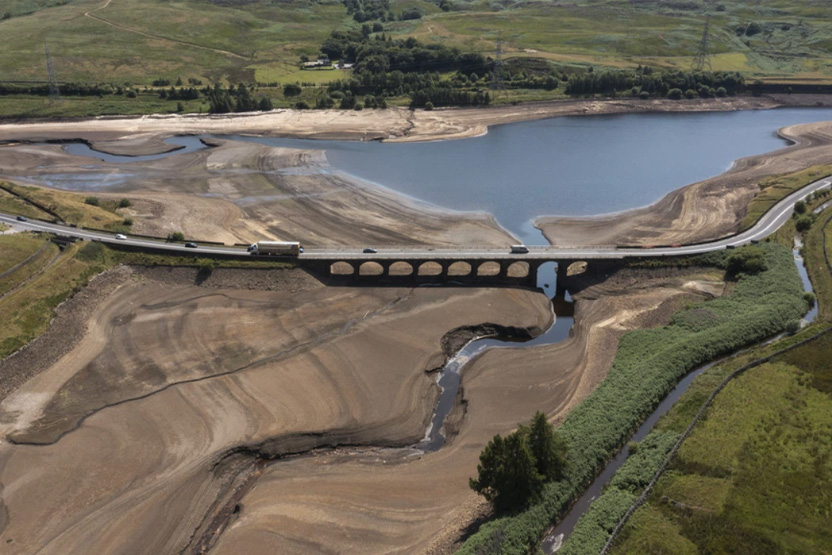
A reservoir in West Yorkshire which is drying up due to lack of rainfall. (zerowaterloss)
A new analytical study has sounded the alarm over rapidly declining freshwater reserves across Europe, particularly in the south and central regions — from Spain and Italy to Poland, with parts of the United Kingdom also affected.
Drawing on satellite data collected between 2002 and 2024, researchers found a persistent drop in water stored in soils, rivers, lakes, and underground aquifers. The pattern, they say, reveals the accelerating impact of human-driven climate change on the continent’s water systems.
A Continent Split in Two: The North Gets Wetter, the South Dries Out
The study highlights a striking hydrological divide. Northern and northwestern areas — including Scandinavia, parts of the UK, and even parts of Portugal — have become increasingly saturated.
But large swaths of the south and southeast — Spain, Italy, France, Switzerland, Germany, Romania, Ukraine, and parts of Britain — show a long-term drying trend.
“We’re no longer talking about holding global warming below 1.5°C,” said Mohammad Shamsudduha, a professor of water-crisis studies at the UCL in an interview with ThaGardian.
Aquifers Under Mounting Stress
When analysing groundwater separately, scientists found that these deeper, more resilient water reserves are declining as well, mirroring the surface trends. This suggests that Europe’s hidden freshwater buffers are being depleted faster than they can recover.
While total water withdrawals in the EU fell between 2000 and 2022, groundwater extraction rose by 6%, driven largely by an 18% rise in municipal drinking-water demand and a 17% increase in agricultural use.
By 2022, aquifers supplied 62% of all drinking water in the EU and roughly one-third of irrigation water — a level experts call unsustainable as droughts become more frequent and severe.
EU Pushes for Greater Water Resilience
Reacting to the findings, the European Commission said its water-resilience strategy aims to help member states adapt their water management systems to a warming climate by reducing human-induced pressures and improving efficiency.
Brussels is promoting a shift toward a “water-smart economy”, aligning with its recommendation to increase water-efficiency by at least 10% by 2030.
With water-loss rates ranging from 8% to 57% across Europe’s supply networks, infrastructure upgrades have become a central priority.
The study’s conclusions echo other recent global research showing that continents worldwide are becoming drier at a faster rate, threatening long-term freshwater availability, contributing to sea-level rise, and pushing millions of people into more frequent and more severe droughts.






Comment