



03 Feb 2026

Tired Earth
By The Editorial Board
by Okayama University of Science
edited by Stephanie Baum, reviewed by Robert Egan, phys.org
A research group has revealed through seismic wave analysis that the oceanic plate beneath the Ontong Java Plateau—the world's largest oceanic plateau—was extensively altered by massive volcanic activity during its formation. The study is published in Geophysical Research Letters.
The oceanic plate beneath the Ontong Java Plateau (OJP) has a composite structure consisting of layered structures overlaid by dike swarms. Low seismic velocity anomalies within the plate suggest chemical modification by magma derived from a thermochemical plume. These findings demonstrate that oceanic plates can undergo significant physicochemical modification due to large-scale volcanic activity, contributing to a comprehensive understanding of plate formation processes.
The research was led by Lecturer Azusa Shito of Okayama University of Science, together with Associate Professor Akira Ishikawa of the Institute of Science Tokyo and Professor Masako Yoshikawa of Hiroshima University.
The Ontong Java Plateau (OJP) is the world's largest oceanic plateau, located in the Pacific Ocean, and was formed by submarine volcanic activity approximately 110–120 million years ago. This volcanic activity—considered the largest in Earth's history—is thought to have drastically altered the global environment at the time and to have triggered mass extinctions.
Recent studies have suggested that this large-scale volcanic activity was caused by a thermochemical plume, an upwelling originating from deep within the mantle. However, the effects of magma ascending from deep mantle sources on pre-existing oceanic plates have remained poorly understood.
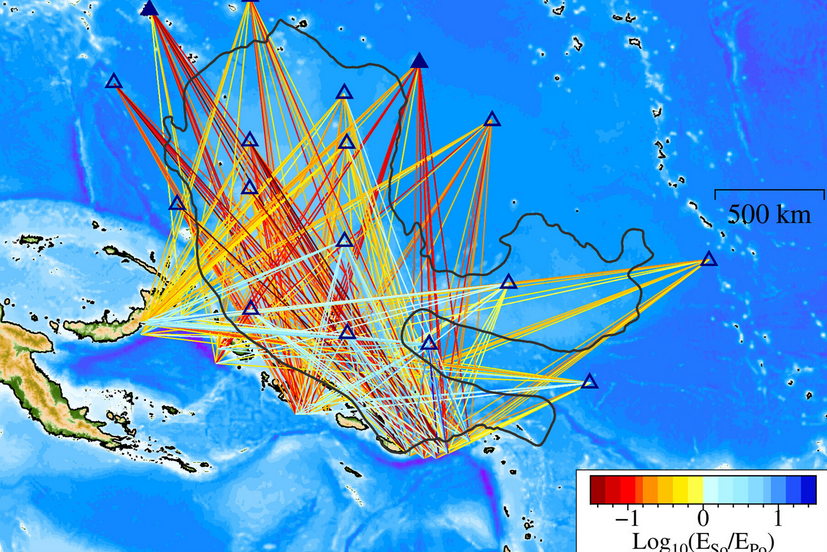
In this study, the team analyzed high-frequency seismic waves known as Po and So waves, recorded by ocean-bottom seismometers deployed around the OJP as well as by seismometers installed on oceanic islands. Po and So waves propagate within oceanic plates, and their propagation characteristics are highly sensitive to the internal structure of the plate.
Under typical conditions, Po and So waves are generated when P and S waves undergo multiple scattering within layered structures inside the oceanic plate, allowing them to travel distances of several thousand kilometers. However, Po and So waves observed around the OJP exhibited a striking feature: While Po waves propagated efficiently, So waves were strongly attenuated.
To reproduce this observation, the researchers estimated the internal structure of the plate using seismic waveform modeling. The results indicated that the oceanic plate beneath the OJP has a composite structure in which layered structures (horizontal lamination) are intersected by dike swarms (vertical intrusion).
In addition, the team found that Po and So waves propagating through the plate beneath the OJP travel significantly more slowly than those in typical oceanic plates. To explain these observations, they propose a model in which magma derived from a thermal-chemical plume ascended through the plate, forming dike swarms, and subsequently caused chemical modification (i.e., refertilization) of the plate.
The model of physicochemical modification of oceanic plates presented in this study is expected to contribute to a more comprehensive understanding of plate formation processes.
photo: Map showing the Ontong Java Plateau (OJP) and ray paths of Po and So waves. The outline of the OJP (Coffin et al., 2006) is represented by a black line. Colored lines indicate ray paths of the Po and So waves observed in the OJP. The color scale indicates the energy of So waves relative to Po waves (ESo/EPo). Open and solid triangles indicate ocean bottom seismic stations and island seismic stations, respectively. Credit: Geophysical Research Letters (2025). DOI: 10.1029/2025gl115219
Source : phys.org

The best of Tired Earth delivered to your inbox
Sign up for more inspiring photos, stories, and special offers from Tired Earth
By signing up for this email, you are agreeing to news, offers, and information from Tired Earth. Click here to visit our Privacy Policy.




Comment