



16 Mar 2026

Tired Earth
By The Editorial Board
by ETH Zurich
edited by Sadie Harley, reviewed by Robert Egan
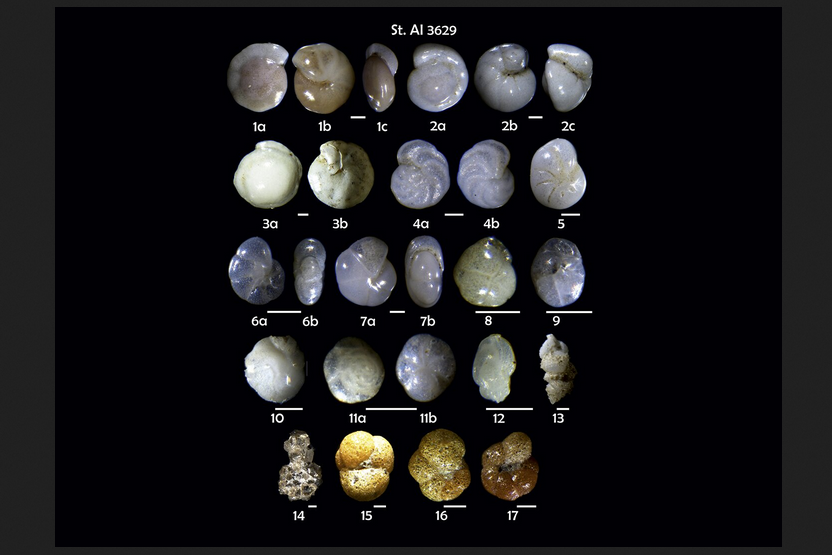
Using fossil benthic foraminifera, whose shells—through their chemical composition make sea-level fluctuations traceable, scientists were able to show that the current increase in day length—1.33 milliseconds per century—stands out clearly over the last 3.6 million years. Credit: ETH Zurich
Climate change is lengthening our days because rising sea levels slow Earth's rotation. Researchers from the University of Vienna and ETH Zurich now show that the current increase in day length—1.33 milliseconds per century—is unprecedented in the past 3.6 million years. The team reconstructed ancient day-length fluctuations using the fossil remains of single-celled marine organisms known as benthic foraminifera.
An exact 24-hour day is not a given—day length changes due to gravitational effects of the moon, as well as various geophysical processes acting within Earth's interior, at its surface, and in the atmosphere.
Today's climate change also affects day length: prior work showed that from 2000 to 2020 our days were lengthened by a rate equivalent to 1.33 milliseconds per century due to climate-related factors, especially the continental-ocean mass redistribution due to the melting of polar ice sheets and mountain glaciers.
In a new study, appearing in the Journal of Geophysical Research: Solid Earth, Mostafa Kiani Shahvandi (University of Vienna) and Benedikt Soja (ETH Zurich) demonstrate that this rapid rise in day length is unparalleled over the last 3.6 million years.
"In our earlier work, we showed that the accelerated melting of polar ice sheets and mountain glaciers in the 21st century is raising sea levels, which slows Earth's rotation and therefore lengthens the day—similar to a figure skater who spins more slowly once they stretch their arms, and more rapidly once they keep their hands close to their body," explains Mostafa Kiani Shahvandi of the University of Vienna's Department of Meteorology and Geophysics.
"What remained unclear was whether there were earlier periods when climate increased day length at a similarly rapid pace."
To answer this question, the researchers used the fossilized remains of single-celled marine organisms known as benthic foraminifera.
"From the chemical composition of the foraminifera fossils, we can infer sea-level fluctuations and then mathematically derive the corresponding changes in day length," says first author Kiani Shahvandi from the University of Vienna.
To draw more robust conclusions, the team employed a probabilistic deep learning algorithm—a physics-informed diffusion model.
"This model captures the physics of sea-level change, while remaining robust to the large uncertainties inherent in paleoclimate data," adds the climate scientist and geophysicist.
During the Quaternary (2.6 million years), the growth and melting of large continental ice sheets repeatedly caused significant day-length variations via sea-level changes. Compared with values from the 21st century, however, it is clear that today's increase in day length stands out in the climate history of the past 3.6 million years.
"Only one time—around 2 million years ago—the rate of change in length of day was nearly comparable, but never before or after that has the planetary 'figure skater' raised her arms and sea levels so quickly as in 2000 to 2020," says Kiani Shahvandi.
"This rapid increase in day length implies that the rate of modern climate change has been unprecedented at least since the late Pliocene, 3.6 million years ago. The current rapid rise in day length can thus be attributed primarily to human influences," says Benedikt Soja, Professor of Space Geodesy at ETH Zurich.
"By the end of the 21st century, climate change is expected to affect day length even more strongly than the moon. Even though the changes are only milliseconds, they can cause problems in many areas, for example in precise space navigation, which requires accurate information on Earth's rotation."
photo: Using fossil benthic foraminifera, whose shells—through their chemical composition make sea-level fluctuations traceable, scientists were able to show that the current increase in day length—1.33 milliseconds per century—stands out clearly over the last 3.6 million years. Credit: ETH Zurich
Source : phys.org

The best of Tired Earth delivered to your inbox
Sign up for more inspiring photos, stories, and special offers from Tired Earth
By signing up for this email, you are agreeing to news, offers, and information from Tired Earth. Click here to visit our Privacy Policy.





Comment