



20 Mar 2026

Tired Earth
By The Editorial Board
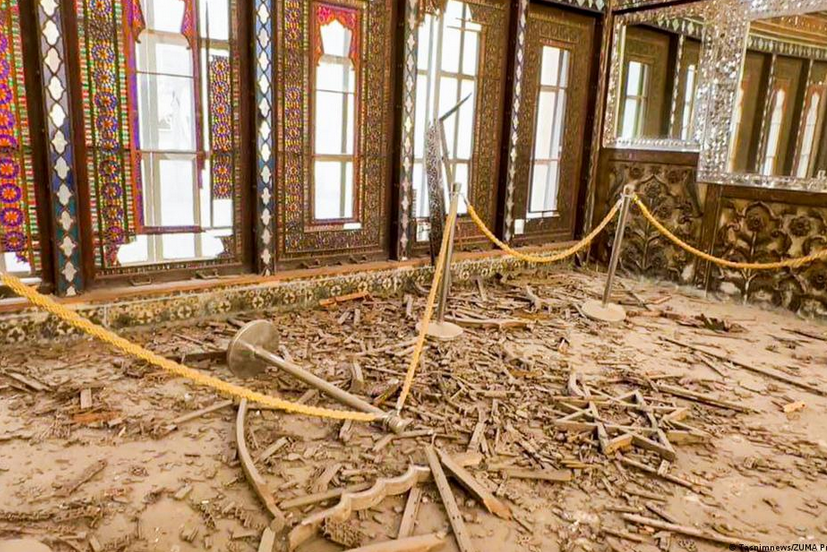
The ongoing war of the United States and Israel against Iran has already raised profound concerns across human, legal, and environmental dimensions. Yet beyond these grave violations, a new and deeply troubling layer has emerged: the systematic damage to cultural and historical heritage. This dimension transforms the conflict into not only a geopolitical and humanitarian crisis, but also a confrontation with history itself.
At least 56 cultural sites—including museums, historic monuments, and heritage complexes—have been damaged or destroyed since the beginning of the war on February 28. These damages are not confined to isolated regions but span multiple provinces, including Tehran, Isfahan, Kurdistan, Lorestan, Kermanshah, Bushehr, and Ilam. The scale and geographic spread suggest not incidental harm, but a pattern with far-reaching implications.
Ancient Heritage Under Fire
Among the most significant sites affected is Golestan Palace, a UNESCO World Heritage Site dating back to the Qajar era (1789–1925). This palace complex—approximately 200 years old—represents a unique fusion of Persian architectural traditions with European influences. Its mirrored halls, intricate mosaics, and landscaped gardens have long symbolized Iran’s cultural synthesis and historical continuity. Recent images show shattered glass ceilings, collapsed archways, and severe structural damage.
Another major site impacted is Naqsh-e Jahan Square, constructed between 1598 and 1629 during the Safavid period. At over 400 years old, it stands as one of the largest and most historically significant public squares in the world, surrounded by monumental mosques and palaces. Damage to this site represents not only physical destruction but a rupture in the continuity of one of the most important urban ensembles in Islamic architecture.
_1773992351.png)
An explosion near Isfahan’s Naqsh-e Jahan Square on March 9, 2026, occurred as a large crowd of locals gathered in the historic square to express solidarity with the children killed in the Minab school attack.
In Tehran, parts of the historic Grand Bazaar—some sections of which date back over two centuries to the Qajar period—have also been affected. This marketplace is not merely a commercial hub but a living cultural institution that has played a central role in Iran’s social and political life.
Further west, the Falak-ol-Aflak Castle, a fortress with origins dating back to the Sassanian era (approximately 1,700 years old), has sustained damage. While its main structure remains standing, even partial destruction of such an ancient site represents an irreplaceable loss.
UNESCO has also verified damage to several other historically significant locations, including the Chehel Sotoun Palace (17th century), and the Jameh Mosque of Isfahan, whose origins trace back over a millennium, making it one of the oldest Friday mosques in Iran. Even more striking is reported damage near the Khorramabad Valley, where archaeological evidence of human habitation dates back approximately 65,000 years—placing it among the earliest known sites of human presence in the region.
_1773994476.png)
Known for its intricate and detailed frescoes, Chehelsotun Palace is one of the most famous historical monuments in Isfahan. This 17th-century pavilion is part of another UNESCO World Heritage Site, the Persian Garden, and was used for royal receptions and ceremonies during the Safavid era.
Cultural Centers and Regional Identity
In the city of Sanandaj, widely regarded as the cultural capital of Iran’s Kurdish region, several historic mansions have been affected. These include centuries-old structures such as the Asef Mansion, the Salar Said Mansion, and the Khosroabad Mansion. These buildings embody a distinctive blend of Kurdish and Persian architectural traditions and are integral to the cultural identity of the region.
Their damage highlights a key feature of modern warfare: the proximity of historical landmarks to urban and administrative centers makes them especially vulnerable. Even when not directly targeted, their destruction becomes an almost inevitable consequence of high-intensity strikes in densely populated areas.
Violations of International Law
The targeting—or failure to adequately protect—cultural heritage sites raises serious legal concerns under international law. The Hague Convention of 1954 explicitly obliges all parties in a conflict to safeguard cultural property. Similarly, United Nations Security Council Resolution 2347 condemns the destruction of cultural heritage and recognizes it as a threat to international peace and security.
All parties involved in the current conflict are signatories to the Hague Convention. Moreover, UNESCO had reportedly provided precise geographical coordinates of heritage sites prior to the outbreak of hostilities, urging all actors to take preventive measures. Despite these precautions, damage has occurred across multiple protected locations, raising questions about compliance and accountability.
Efforts have been made domestically to protect these sites, including the installation of the “Blue Shield” emblem—an internationally recognized symbol marking protected cultural property—on more than 120 museums and historical buildings. However, such measures have proven insufficient in the face of modern warfare technologies.
A Conflict Against Memory
The destruction of cultural heritage cannot be reduced to collateral damage alone. These sites are repositories of collective memory, identity, and historical continuity. When they are damaged or destroyed, the loss extends beyond national borders—it becomes a loss for humanity as a whole.
The contrast is particularly stark: states with relatively recent national histories are now involved in military actions that have damaged monuments spanning centuries or even millennia. Whether intentional or incidental, this asymmetry underscores a deeper tension between short-term strategic objectives and the long-term preservation of human civilization.
Donald Trump, President of the United States, had previously threatened in January 2020 to target Iran’s cultural sites. Military attacks that target cultural sites are considered war crimes under international law. The United States, Israel, and Iran have signed conventions for the protection of cultural heritage during times of conflict.
Pete Hegseth, the U.S. Secretary of Defense, spoke in a dismissive tone about the conventions and laws established to reduce risks to civilians, referring to them as “stupid rules of engagement.”
The U.S. Committee of the Blue Shield stated that it was “concerned” by Hegseth’s remarks and noted that failure to comply with international humanitarian law could lead to the commission of war crimes.
The war in Iran illustrates a dangerous evolution in modern conflict. Beyond human casualties and environmental degradation, it now threatens the very foundations of cultural heritage. Ancient palaces, mosques, marketplaces, and archaeological sites—some thousands of years old—are being irreversibly damaged within days.
This is not merely the destruction of buildings. It is the erosion of history, identity, and shared human legacy.
If international norms designed to protect cultural heritage can be so easily disregarded, then the consequences will extend far beyond this single conflict—reshaping how wars are fought, and what is ultimately lost when they are.
Photo: Damage caused by explosions at Golestan Palace-Museum

The best of Tired Earth delivered to your inbox
Sign up for more inspiring photos, stories, and special offers from Tired Earth
By signing up for this email, you are agreeing to news, offers, and information from Tired Earth. Click here to visit our Privacy Policy.





Comment