



26 Jan 2026

Tangwa Abilu
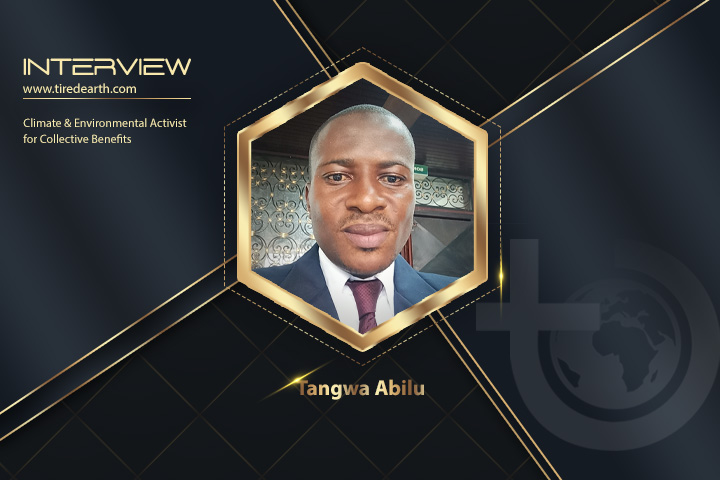
1. What experience led you to focus on climate change issues and conservation of the ecosystems?
My commitment to climate change and ecosystem conservation is rooted in my lived experience and has evolved into a professional and advocacy mission.
I grew up in Mbolive,an agrarian community in Cameroon where about 90% of people depended on agriculture. My childhood memory is marked by trekking kilometers with my community to farm in an area we called Mbamkov ‘the place that was once forest.” But between 2000 and today, I witnessed a devastating transformation. The River Mbolive dried up, forcing a daily migration for water. Farm yields collapsed due to prolonged droughts and new pests, like the fall armyworm,proliferated by the changing climate.This crisis was accelerated by unsustainable practices like slash-and-burn agriculture,which stripped the land, destroyed the forest, and degraded the soil in a vicious cycle.
The human cost was profound. My parents funded my education from that diminishing farmland. I saw my generation, from around 2005, lose its livelihood. Many were forced to migrate, becoming climate refugees in search of new land or work in urban centers. Witnessing this direct link between environmental collapse and the disintegration of my community's way of life was my first and most powerful lesson.
This inspired me to pursue a degree in Geography at the University of Yaoundé 1Camaeroon with a clear mission: to find solutions. My academic path provided the analytical framework. My Master's thesis on the Impact of Post-harvest Management on Socio-economic Development revealed how climate vulnerability creates cascading socio-economic losses, confirming that the challenges were systemic and interconnected.
That journey, from the fields of Mbolive to the research in Yaoundé defined my purpose. It pushed me to broaden my advocacy to protect critical global ecosystems like the Congo Basin and the Amazon, understanding that this is a collective battle.
But I also learned that action without education is incomplete. I firmly believe climate education is a critical pillar of sustainability. That’s why I advocate at every level, from village meetings to school classrooms to my social media platforms. Everyone must understand the consequences of our actions on the environment to empower change. My goal is to help build the awareness necessary to curb this global threat and ensure future generations can enjoy a healthy, thriving planet.
2. In your opinion, which ecosystem are currently at the greatest risks of loss, and why?
The world's primary tropical rainforests, the Amazon, Congo Basin, and Southeast Asian peat lands, face the greatest immediate risk of irreversible loss.
As a climate activist from Cameroon, deep in the heart of the Congo Basin, I feel the urgency of this crisis every day. Our tropical rainforests, the Congo Basin, the Amazon, and Indonesia's forests, are irreplaceable allies in the fight against climate change. They act as massive carbon sinks, regulate global rainfall, preserve unmatched biodiversity, and support the livelihoods of millions, including indigenous communities like those in my country. Yet, these ecosystems face the greatest risk of irreversible loss right now, driven by a deadly mix of human activities (logging, agriculture, mining) and climate-amplified threats like droughts and fires.
In my opinion, the Congo Basin currently stands at the highest risk of sustained, accelerating loss. While the Amazon shows policy-driven improvements in clear-cut deforestation (though fires remain a massive threat), and Indonesia has achieved reductions in primary forest loss, the Congo Basin's degradation,fueled by small-scale slash-and-burn farming, charcoal production, timber extraction (legal and illegal), and mining, continues to climb, exacerbated by population growth, poverty, conflict, and weak enforcement. In Cameroon, timber logging and agricultural expansion are intensifying, turning our forests into an "emerging frontier" of disturbance.
The Amazon is near its tipping point (17% deforested; the threshold is 20-25%). At this point, it would degrade into a dry savanna, disrupting global weather patterns. Primary driver: industrial cattle ranching and soy. (Source: Lovejoy & Nobre, Science Advances, 2018; Global Forest Watch, 2024).
The Congo Basin, the world's last net carbon sink, is under siege. Deforestation for timber, slash-and-burn farming, and mining is accelerating. Its vast peat lands store 30 billion tonnes of carbon. Loss here would be a catastrophic climate blow. (Source: Global Forest Watch, 2024; CIFOR, 2022).
Southeast Asian peat lands remain a high-emissions risk. When drained for plantations like palm oil, they become tinderboxes, releasing colossal carbon stores during fires. (Source: WRI, 2015; Global Forest Watch, 2024).
The core threat is governance failure. We must "hold caution the actions of these governments." Short-term economic interests, corruption, and weak enforcement prioritize timber, beef, and palm oil over our planet's vital climate allies. Protecting these ecosystems is the ultimate climate technology.
3. How can a balance be maintained between human development and the preservation of our natural ecosystem in sensitive areas.
Balancing human development with the preservation of natural ecosystems in sensitive areas is a core challenge in sustainable development,and it aligns directly with the three pillars: environmental protection, social equity, and economic viability. In my view, every development endeavor must integrate these pillars from the outset to avoid trade-offs that favor short-term gains over long-term resilience. Here's how I believe this balance can be achieved:
Firstly, through integrated planning and environmental impact assessments (EIAs). Before any project begins, rigorous EIAs should evaluate potential effects on ecosystems, incorporating scientific data on biodiversity, soil health, water resources, and climate vulnerability. For instance, in sensitive areas like rainforests or coastal zones, zoning regulations can designate "no-go" areas for development while allowing low-impact activities in buffer zones. This ensures environmental sustainability while enabling social and economic benefits, such as job creation in eco-tourism or sustainable agriculture.
Secondly, by leveraging technology and innovation. Tools like Geographical Information System mapping, remote sensing, and AI-driven monitoring can help track ecosystem health in real-time, allowing developers to minimize disruption. For example, in infrastructure projects, adopting green technologies, such as permeable pavements to reduce runoff or wildlife corridors under highways,can support human mobility without fragmenting habitats. This approach upholds economic growth by reducing long-term costs from environmental degradation, like erosion or species loss.
Thirdly and imperatively, community involvement and inclusive governance. Local communities, especially indigenous groups who often steward sensitive ecosystems, must be active participants in decision-making. This fosters social sustainability by respecting cultural values and ensuring equitable benefits, such as revenue-sharing from conservation-linked enterprises. Policies like payments for ecosystem services (PES) can incentivize preservation, where communities are compensated for maintaining forests or wetlands, creating a win-win for human livelihoods and nature.
Finally, enforcing adaptive management and policy frameworks. Development isn't static; regular monitoring and flexible strategies allow adjustments based on new data or changing conditions, like climate shifts. International frameworks, such as the UN Sustainable Development Goals (SDGs), particularly SDG 15 (Life on Land) and SDG 13 (Climate Action), provide blueprints for this, emphasizing that economic progress must not compromise planetary boundaries.
4. How would you assess the current state of the environment in BRAZIL
The current state of Brazil's environment, particularly in the Amazon and Cerrado, reflects meaningful progress in reducing deforestation, but serious ongoing risks from degradation and fires demand vigilance.
Latest official statistics (INPE PRODES, August 2024–July 2025, released October 2025):
- Amazon: 5,796 km² deforested - down 11.08% from the prior year, the lowest level in 11 years (since 2014) and the third-lowest since monitoring began in 1988.
- This marks the fourth consecutive year of decline, with a cumulative 50% reduction compared to 2022 peaks under the current administration.
- Cerrado: 7,235 km² deforested -down 11.49%, the lowest in five to six years and the second year of decline after prior increases.
Burned areas (INPE DETER monitoring) also fell sharply: down 45% in the 12 months to September 2025 compared to the same period ending 2024 (from 39,310 km² to 21,543 km²), with some sources noting even steeper early-2025 drops (up to 80% in parts of the Amazon year-to-date).
These reductions result from reinstated enforcement,real-time satellite monitoring (PRODES/DETER), protected areas, and policy commitment. Yet any good policy without rigorous monitoring and evaluation is effectively nothing. Brazil's gains depend on transparent, science-based systems like INPE's; sustained funding, independent audits, adaptive management, and public access to data are essential to prevent rebounds, detect hidden illegal activity, or catch shifts toward degradation.
Persistent challenges include:
- Rising forest degradation (e.g., from repeated fires and selective logging), which increased sharply in recent years (up 163% from 2022 to 2024 in some analyses) and often precedes full deforestation.
- Climate change amplifying droughts and fire risk, pushing parts of the Amazon closer to tipping points.
- Agriculture, mining, and infrastructure pressures, with much deforestation (89% in Amazon in 2025) remaining unauthorized.
In summary, Brazil shows strong, data-backed policy impact on deforestation control, but long-term success hinges on unbreakable commitment to monitoring, evaluation, and addressing degradation and climate feedbacks to secure, and ideally surpass, the 2030 zero-deforestation target
5. What role do national and international policies play in reducing deforestation, and how can their effectiveness be improved?
National and international policies are essential for reducing deforestation, but their success depends heavily on how they are designed and enforced. The evidence from key forest nations shows a pattern of significant potential when policies are robust and of failure when they are weakened or circumvented.
National Policies: The Foundation for Success or Failure
National governments set the legal framework and enforcement capacity on the ground. Effective policies typically combine monitoring, legal protection for forests, and conditional economic incentives.
What Works: Evidence from Brazil (2004-2012)
Persistent Challenges & Contradictions
International Policies: Creating Accountability and Levers
International policies create external pressure, set global standards, and provide financial support, but they must be fair and well-coordinated.
The Risk of "Spillover": Poorly designed national policies in one country can shift environmental damage to another. Truly effective international cooperation is needed to prevent this.
Key Recommendations for Improving Effectiveness
To address the above gaps , the effectiveness of these policies can be dramatically improved by focusing on four interconnected areas:
1. Center and Compensate Indigenous and Local Communities
2. Ensure Transparent, Direct, and Conditioned Financial Flows
Example: Cameroon's law states that half of the annual forestry area fee is paid to local councils, with a portion earmarked for community projects—a mechanism that requires strict oversight to ensure fulfillment.
3. Invest in Integrated Monitoring and Consistent Enforcement
4. Align All Policies with a "Zero-Deforestation" Goal

The best of Tired Earth delivered to your inbox
Sign up for more inspiring photos, stories, and special offers from Tired Earth
By signing up for this email, you are agreeing to news, offers, and information from Tired Earth. Click here to visit our Privacy Policy.
Comment
Reply