



14 Oct 2026

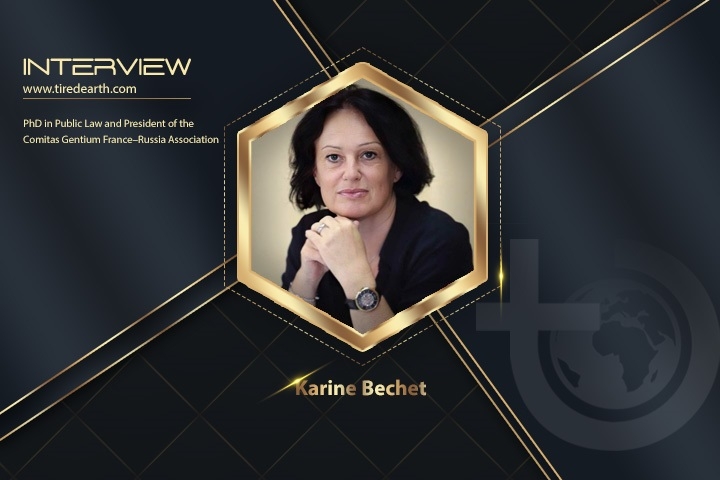
Karine Bechet
"We are facing not a Third World War, but rather a First Global War, because it is not sovereign countries fighting each other, but rather globalist elites using the structures of the countries they control to defend their own interests."
1. According to you, what are the common factors between the war in Ukraine and the war in Iran, which has continued since February 2026 following the attacks carried out by the United States and Israel against this country?
The war in Ukraine and the war in Iran stem from the same logic, with the difference being that the Ukrainian conflict is a primary conflict, whereas the Iranian conflict is a secondary conflict. In this sense, the existence of globalist elites, who are fighting on both fronts, is at stake in Ukraine.
We are facing not a Third World War, but rather a First Global War, because it is not sovereign countries fighting each other in their own interests, but rather globalist elites using the structures of the countries they control in order to use their resources (human, political, military, etc.) to defend their own interests, which have nothing to do with, and are often in contradiction with, the interests of the countries being dominated and instrumentalized.
Furthermore, in both cases, we see that negotiations are merely another front like any other. The Globalists use negotiations to achieve victory; if this is not possible, they break their promises or unilaterally withdraw from negotiations.
2. War and public debt in Ukraine, which recently reached a record level of more than $214 billion: Is Ukraine still a sovereign state, or has it now become merely an instrument in the hands of great powers?
Ukraine is not a sovereign state, but not because of the level of its debt. It lost its statehood, meaning its quality as a state, at least in 2004, during the organization, under the auspices of the OSCE and with the very active support of the Anglo-Saxons (Canada’s role here is not insignificant), and of American “democracy promotion” organizations.
By nullifying the results of the second round of the Ukrainian presidential elections because the winner did not suit them, the globalist elites destroyed the Ukrainian political system. This constitutes a genuine legal aggression.
Ten years later, because Ukrainians decided to return to power the candidate rejected by the West, and because the prospect of new presidential elections was not looking favorable for these elites, the Maidan was organized in 2014, and society was drowned in blood with the help of extremist neo-Nazi groups (Azov, Aidar, Pravyi Sector, etc.) armed, trained, and financed by the West. This definitively destroyed Ukraine as a state.
Historically, during the millennium in which Ukraine was part of Russia, it became independent three times. And three times it was instrumentalized by the West against Russia.
At the fall of the Russian Empire, it came under European control; during the Second World War, it was under Nazi control and active cooperation; and after the collapse of the USSR, it was governed by globalist elites who imposed themselves everywhere.
3. Six months after the beginning of the American and Israeli attacks and the death of former Supreme Leader Ali Khamenei, the Iranian regime is still in place. In your view, can a winner and a loser of this war already be determined, or should we expect further developments, particularly a new economic war?
Militarily, it is still difficult to determine a winner. But politically, the United States has lost this battle, due to the prematurely victorious statements made by Trump, which were followed by statements of a warlike nature.
But because the United States cannot acknowledge or consider defeat, and because Israel cannot fight without them, this conflict risks becoming prolonged.
Iran’s resistance demonstrates the real limits of the Globalists, both militarily (because they cannot afford a large-scale ground intervention) and in terms of economic warfare (Iran is resistant to sanctions and has demonstrated this).
4. Russia and China remain important trading partners of Iran. Can the new mechanisms put in place by the United States, which also threaten third countries, genuinely succeed in isolating Tehran, or could they instead encourage the creation and expansion of a parallel economic network?
Since Russia and China are already targeted by American sanctions, the sanctions adopted against Iran will have little effect on them.
Even regarding China, the United States cannot go too far, because it needs Chinese productivity to ensure global supply.
On the other hand, the generalization of sanctions outside the framework of the United Nations, based on very specific political interests, discredits both what remains of economic liberalism and economic globalization — which is becoming less and less global.
5. Wars, Trumpism, double standards, human rights: according to its critics, France is no longer, in its international decisions, the independent France it once was. What is your analysis?
Sovereign France, as an international actor, has unfortunately disappeared. European integration has completed this process, depriving it in reality of the autonomy of international decision-making, which is necessary for any state to ensure its sovereignty, known as “external sovereignty.”
However, the European Union is not an autonomous European structure that defends the interests of European countries either. It is a regional body of global governance.
Therefore, France, like all European countries, now finds itself at the bottom of the political hierarchy.
6. The conflicts in Ukraine and the Middle East also have serious environmental consequences. In your view, would it be possible to establish stronger international mechanisms to prevent environmental damage caused by armed conflicts?
Wars have always had significant human and environmental consequences, because they are periods of destruction.
Rules have been adopted within the framework of international humanitarian law in an attempt to limit the devastating effects of armed conflicts. However, periods of war are, in reality, periods of legal nihilism by definition: it is the rule of force, rather than the rule of law.
Furthermore, the environmental issue has been heavily ideologized and discredited in recent years, causing it to lose its primary purpose, which is to ensure an environment favorable to humans and their development.
Currently, no international regulation in this area would truly be able to limit the devastating effects of armed conflicts, because international law reflects a stabilized balance of international power. This is not the case today.
Moreover, since the globalist elites still hold power in all international institutions, without exception, they would only pass yet another text reflecting and serving their ideology, which has nothing humanistic about it and does not take into consideration the preservation of the human environment — without falling into fanaticism or the instrumentalization of the issue.

The best of Tired Earth delivered to your inbox
Sign up for more inspiring photos, stories, and special offers from Tired Earth
By signing up for this email, you are agreeing to news, offers, and information from Tired Earth. Click here to visit our Privacy Policy.
Comment
Reply