


19 Oct 2026
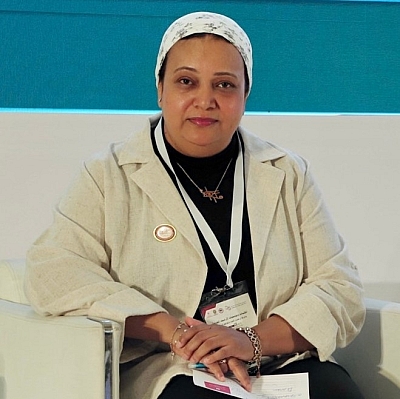
Dr. Heba Mohamed Ismail
Libraries and cultural institutions have a vital role to play in climate change awareness because addressing the climate crisis requires more than scientific knowledge and government policies; it requires informed, engaged, and empowered communities.
By Selva Ozelli
Dr. Heba Mohamed Ismail is Libraries Technical Manager at Egypt’s Society for Culture and Development; Chair of Education and Training Committee, Arab Federation for Libraries and Information. She is involved in regional climate action in MENA and international sustainability networks. As a representative of the International Federation of Library Associations and Institutions (IFLA Regional Division Committee for MENA), she advocates for the role of libraries and cultural institutions in climate action. Her work contributes to the Culture Global Stocktake for Climate Action, a policy framework entering its final drafting stages ahead of COP31. She actively works within African and Middle Eastern intellectual networks to integrate regional perspectives into climate policy, bridging cultural heritage with global sustainability metrics.
1. Tell us about your journey to becoming the Chair of Education and Training Committee, Arab Federation for Libraries.
My journey to becoming the Chair of the Education and Training Committee at the Arab Federation for Libraries and Information (AFLI) has been shaped by a firm belief that a librarian’s education never truly ends. Throughout my professional career as a librarian and my work, I have remained committed to continuous professional development, knowledge sharing, and strengthening the competencies of library and information professionals across the Arab region.
This journey began in 2011, when I joined the International Network of Emerging Library Innovators (INELI), a program funded by Global Libraries (GL) Initiatives at the Bill & Melinda Gates Foundation (BMGF). This experience marked an important milestone in my professional development, broadening my perspective on library innovation, leadership, and the power of international collaboration. The knowledge, insights, and experience I gained through INELI have continued to shape my professional outlook and reinforce my commitment to developing the skills and competencies of library and information professionals across the Arab region. Today I carry thus commitment forward as Chair of AFLI’s Education and Training committee, working to promote lifelong learning and support the continuous development of our profession.
My volunteer work and leadership journey within AFLI span over a decade:
My active involvement with AFLI started back in 2013 when Prof. Emad Saleh, current President of AFLI, nominated me to Prof. Hassan Al-Sereihy, who was serving as AFLI President at that time, to conduct AFLI webinars. Since then, I started to work voluntarily with AFLI.
In 2015, following the INELI training, I suggested that AFLI take the lead and ask GL to implement the program regionally. We succeeded in obtaining funding from BMGF to implement the regional program, so we started the "International Network of Emerging Library Innovators – Middle East and North Africa (INELI-MENA)", although the funding eventually came to an end, the program’s impact has endured, with its activities continuing at the national level across the MENA region.
Following that milestone, I supported AFLI in securing many grants to implement training programs for librarians, such as "The 2030 Arab Librarians: Online Program Towards the Road to the SDGs" from IFLA; "Staff E-training on Emerging technology & Developed Services (Seeds") funded by EBSCO Information Services; and "Enhancing Open Science Adoption in the MENA Region" from Data Cite Global funds.
After leading these training and grant initiatives, I nominated myself as Vice President of AFLI and was selected. Once my tenure ended in November 2025, I nominated myself as AFLI Chair of the Training and Education Section.
My academic research on e-training networks for public librarians further strengthened my interest in exploring how digital learning can expand access to professional education and overcome geographical and institutional barriers. Through my work with AFLI, I have contributed to regional training initiatives that combine theoretical knowledge with practical application, encouraging professionals not only to acquire new skills but also to translate their learning into innovative projects and improved library services.
Becoming Chair of the Education and Training Committee is both an honor and a responsibility. It allows me to build on these experiences, collaborate with colleagues across the Arab world, and support professional development that responds to emerging challenges, including artificial intelligence, digital transformation, sustainability, and the evolving role of libraries in society. For me, the ultimate goal is to empower library professionals to become lifelong learners, active knowledge creators, and agents of positive change in their communities.
2. What is the role of libraries and cultural institutions in climate change awareness?
Libraries and cultural institutions have a vital role to play in climate change awareness because addressing the climate crisis requires more than scientific knowledge and government policies; it requires informed, engaged, and empowered communities.
In my research, The Role of Public Libraries in Strengthening the Mechanisms of Action for Climate Empowerment (ACE): An Exploratory Study of Public Library Programmes, Services and Activities in Egypt and the United Arab Emirates, published by IFLA in November 2025, I examined public library programmes, services, and activities across Egypt and UAE. The study explored how libraries contribute directly to the six pillars of Action for Climate Empowerment (ACE) under the United Nations Framework Convention on Climate Change (UNFCCC): Education; Training; Public Awareness; Public Participation; Public Access to Information; International Cooperation
My research highlights that public libraries are much more than places to access books and information. They are trusted community spaces where people of different ages, backgrounds, and abilities can learn about climate change, understand its local consequences, access reliable information, participate in educational activities, and discover practical ways to contribute to sustainable development. Through workshops, educational programs, inclusive activities, digital resources, and partnerships with government institutions and community organizations, libraries can translate complex scientific information into knowledge that is accessible and relevant to everyday life.
The research also identifies important opportunities for improvement. Libraries need:
These findings reinforce my belief that libraries should be recognized as active partners in climate policy and public engagement, rather than simply as venues for occasional awareness events.
Beyond awareness, libraries can help connect global climate commitments with local realities. In the MENA region, this means addressing the climate challenges that communities experience directly, while recognizing the value of local knowledge, cultural heritage, and regional perspectives. Cultural institutions can help preserve and communicate traditional knowledge about water conservation, agriculture, biodiversity, and adaptation, bringing it into dialogue with contemporary scientific research.
Ultimately, libraries and cultural institutions can bridge science, policy, culture, and community action. Their contribution is not only to help people understand climate change, but also to empower them to participate in solutions and imagine more sustainable futures. This potential should be reflected more clearly in national climate strategies and international cultural and climate policy discussions.
3. Which international cultural organizations do you collaborate with?
My work connects library development and professional learning with wider international conversations about information, culture, and sustainability. My climate and heritage collaboration extend directly into working alongside the Climate Heritage Network (CHN) and IFLA. I participated in COP27 in Sharm el Sheikh –through an invitation from IFLA- contributing to the CHN Culture at COP27 working group.
My engagement in these efforts also included in the landmark #ArtCultureHeritageCOP27 day-long program held at the Sharm el Sheikh Musuem, where I attended and contributed to a session exploring the role of culture and heritage in climate action.
These efforts focus on leveraging cultural institutions, libraries, and creative voices to advance the United Nations Action for Climate Empowerment (ACE) agenda, shape climate policy through culture, and contribute to framework like the Culture Global Stocktake ahead of COP31.
These relationships are most valuable when they lead to practical collaboration shared learning and stronger representation of regional perspective in international climate and information discussions.
4. In the face of the growing AI utilization with data centers fueling the climate crisis, will libraries be replaced by AI?
No, I do not believe libraries will ever be replaced by artificial intelligence; on the contrary, the rapid development of AI, alongside the growing environmental footprint of the data centers that power it, makes the physical, social, and human infrastructure of libraries more essential than ever.
Libraries are ethical anchors in the age of AI. While AI can process vast amounts of information and support research, it can also generate inaccurate information, reproduce biases, and produce fabricated reference. Librarians bring human judgment, professional ethics, and cultural understanding to the process of finding and evaluating knowledge. Their role is evolving beyond helping people retrieve information to developing digital and AI literacy, enabling communities to understand how AI work, question their outputs, verify sources and recognize bias. Throughout the ages, libraries have always helped to reduce the digital divide by providing equitable access to information, digital resources, and learning opportunities, regardless of people's financial circumstances.
We must consider the environmental cost of AI, the expansion of data centers increases demand for electricity and water, particularly for cooling, creating additional pressures in regions already experiencing water scarcity and rising temperatures. This is especially relevant to MENA region. Libraries offer a different model of knowledge access: Shared public resources, communal learning, and the reuse of information and educational materials. Although libraries also have an environmental footprint, they can adopt sustainable practices and help communities understand the relationship between technological innovation, resource consumption and climate responsibility. They also provide something that digital platforms cannot fully reproduce safe, welcoming physical spaces for intergenerational learning, social interaction, civic engagement and community building.
Libraries also preserve local languages, oral histories, regional collections and cultural knowledge that may be poorly represented in digital datasets. The future should be collaboration rather than competition. Use AI where it adds genuine value, but keep people, ethics, cultural diversity, and environmental responsibility at the centre.
5. Surveys show roughly 67% of libraries globally are exploring or implementing AI to improve operational workflows. What are your thoughts?
The figure shows that AI has become a serious topic for libraries and librarians, but it is important to distinguish between exploring a tool, piloting it, and fully embedding it in everyday services. The reported 67% figure from Clarivate's 2025 pulse of the library survey reflects respondents exploring or implementing AI; with an increase from 63% in 2024. It should not be read as proof that all have deployed it at scale.
AI may help with repetitive tasks, metadata enrichment, discovery, or translation, accessibility, research support, and analysis of service feedback. If these applications are carefully chosen, they can give library staff more time for user support, teaching, outreach, and complex research needs.
But efficiency should not come at the expense of accuracy, privacy, copyright, accessibility, or trust. Libraries need clear policies on approved tools and data use, human review of outputs, staff training, and evaluation of costs and environmental impacts. Adoption will also look different depending on a library's mission, budget, infrastructure language needs, and users.
For MENA region, collaboration and capacity building can help ensure that smaller and less-resourced institutions are not left behind. The goal should not be to adopt AI as quickly as possible; but to use it responsibly, ethically and strategically where it can improve service quality and deliver meaningful benefits. Recognizing this need, the Arab Federation for Libraries and Information (AFLI) has taken an important step by signing a Memorandum of Understanding (MOU) with Library Juice Academy to provide training courses that promote AI awareness and its responsible use among library and information professionals across the MENA region.
6. AI frequently hallucinates facts and generates fake citations. Will librarians remain vital for teaching patrons how to spot machine bias, evaluate digital content, and verify sources?
When AI can produce fluent but unreliable answers, the key skill is not simply finding information –it is knowing how to evaluate it. Librarians have long taught source evaluation and research skills; these abilities are even more important when information is generated automatically.
Librarians can show users how to check whether a cited article actually exist, compare evidence across independent publications, and assess a source's authority, currency and purpose. They can also explain that AI outputs may reflect gaps or biases in training data, including underrepresentation of particular languages, histories and communities.
The answer is not to tell people never to use AI. It is to help them use it critically: Protect personal information, understand limitations, acknowledge AI assistance where appropriate and seek human expertise when needed. Librarians can make these practices practical through workshops, classrooms partnership, research consolation and everyday conversations with users. In an environment where plausible misinformation can spread quickly, this kind of information and AI literacy is a core public service.
7. Are libraries still recognized as trusted community spaces where scientific knowledge, cultural heritage, and local experiences can come together to help people better understand climate change and imagine sustainable futures?
Libraries can play this role, although their visibility and resources vary by place their distinctive value is that they can bring scientific evidence, cultural memory, local experience, and public discussion into the same space.
Climate change can feel abstract when presented only through technical reports or global statistics, libraries can make it more accessible through talks, exhibitions, curated resources, school activities, workshops and conversations with scientists and community organizations, local knowledge-such a traditional water management, agricultural practices, or climate- responsive architecture- can add context, while scientific evidence helps assess risks and possible Reponses.
My research on public libraries in Egypt and the United Arab Emirates, using the Action for climate Empowerment framework, explores how libraries can contribute trough education, training public awareness, participation, access to information and international cooperation. It also highlights the need for trained staff, relevant resources, partnerships and ways to access impact.
Libraries are not a substitute for climate agencies or scientific institutions; they are valuable partners that can help knowledge reach people and support informed community dialogue. When they connect reliable evidence with local stories and lived experience, they can help people move from uncertainty toward understanding and practical action
8. The Middle East and North Africa (MENA) region is becoming an increasingly essential hub for global data centers, driven by rapid artificial intelligence (AI) adoption, cloud expansion, and national economic diversification strategies. How does this impact air and water pollution in the region?
The expansion of data centers offers opportunities for digital service, investment, and economic development. At the same time, it raises legitimate environmental questions, and the effects depend on the location of each facility, its energy source, cooling technology, water supply, and environmental safeguards. It is important to assess these impacts transparently rather than assume every facility has the same footprint.
Electricity demand is one concern. Where additional power is generated from fossil fuels, it can increase greenhouse-gas emissions and contribute to air pollution; backup generators may also produce local emissions when operated. The scale of the impact depends on the energy mix, efficiency, and how new demand its managed.
Water deserves particular attention in pats of MENA that experience high temperatures and water stress. Some cooling systems consume water, and the implications depend on whether facilities use portable water, treated wastewater, recycled water, or closed-loop systems. Planning should account for local water availability and avoid placing unnecessary pressure on communities, agriculture, and ecosystems, where relevant, the management of waste heat and cooling discharge should also be assessed.
9. The regional conflict involving Iran, Israel, and the U.S. has profoundly disrupted the data centers sector, marking the first time commercial data centers have been targeted directly during wartime. What are your thoughts?
Any attack on digital infrastructure that supports civilian life it deeply concerning. Data centers may seem remote from everyday experience, but they can underpin services used for healthcare, education, finance, communications, public administrations, and access to information. Disruption can therefore far beyond the technology sector.
For libraries and cultural institutions, the implications include potential interruptions to online catalogues, digital collections, research resources, and remote services. Digital heritage can also be at risk if records are stored in a single location or depend on one provider, this makes tested backups, geographically separate copies, disaster- recovery plans, strong cybersecurity, and clear continuity arrangements important institutional preparedness
The issue should be approached with care and a commitment to protecting civilians and cultural heritage, digital resilience is not merely a technical matte; it helps safeguard access to knowledge, educational continuity, and collective memory during of instability.
10. Anything else you would like to add.
I would like to stress that climate action is not separate from the core mission of librarians. Access to trustworthy information, lifelong learning, cultural preservation, inclusion, and community participation all help societies understand and chance and respond to it.
My research on public libraries in Egypt and the United Arab Emirates has strengthened my belief that libraries can contribute to climate empowerment in practical ways. To release this potential, they need recognitions in relevant strategies, investment in staff development, accessible resources, partnerships, and ways to evaluate their impact. Libraries and cultural institutions should be part of climate and cultural-policy conversations from the outset.
As AI and digital infrastructure expand, we should ask not only what technology can do, but who benefits, what knowledge may be missing, and what environmental costs are involved. Libraries can help connect these questions because they work at the intersection of information, education, and community. The phrase I would leave with the readers “Libraries are not just about knowledge anymore—
they are about survival, resilience, and the future.” The question is no longer: Can libraries contribute to climate action? The real question is: Are we ready to unlock their full potential as Climate Futures Labs?
11. How can people reach you?
You can reach and follow my work through the following professional channels:
Resources:
Mohamed Ismail, H., & McGuire, C. (2025). The Role of Public Libraries in Strengthening the Mechanisms of Action for Climate Empowerment (ACE): An Exploratory Study of Public Library Programs, Services and Activities in Egypt and Emirates. International Federation of Library Associations and Institutions (IFLA). Available from IFLA Repository
Clarivate. (2025, October 30). Pulse of the library report reveals link between AI literacy, AI implementation and confidence. https://clarivate.com/news/pulse-of-the-library-report-reveals-link-between-ai-literacy-ai-implementation-and-confidence/

The best of Tired Earth delivered to your inbox
Sign up for more inspiring photos, stories, and special offers from Tired Earth
By signing up for this email, you are agreeing to news, offers, and information from Tired Earth. Click here to visit our Privacy Policy.
Comment
Reply