

25 Jan 2026
Tired Earth
By The Editorial Board
by Maxwell Radwin, published: 20 Jan 2026 at Mongabay.com
When U.S. forces entered Venezuela earlier this month and removed President Nicolás Maduro, officials framed the intervention as a strategic economic opportunity. President Donald Trump repeatedly pointed to the country’s oil reserves and rare earth minerals, saying U.S. companies stood to earn billions of dollars.
Less attention has been paid to the environmental risks of his plan. More than half of Venezuela is covered by forest, some of it in the Amazon Basin. It also has grasslands, wetlands and thousands of kilometers of Caribbean coastline. These ecosystems were already under strain under the Maduro government, but critics warn that foreign intervention could intensify the damage.
“If environmental risks aren’t taken into account in this process, we’re probably facing a potential environmental catastrophe of a very large magnitude,” Eduardo Klein, a marine ecology professor at Simón Bolívar University in Caracas, told Mongabay.
Venezuela has an estimated 300 billion barrels of proven crude oil reserves, the largest in the world. Yet it produces slightly less than a million barrels a day, far below many other oil-producing countries with smaller reserves. By international standards, Venezuela’s oil is heavier than in other parts of the world, making it more costly and requiring special processing equipment.
The government has also allowed pipelines and refineries to fall into disrepair over the last 20 years, the result of financial mismanagement, corruption, an untrained workforce and sanctions. In 2024, there were at least 65 oil spills across eight states, according to the Venezuelan Observatory for Political Ecology. It also recorded eight major fires at facilities run by PDVSA, the state-owned oil company. In Lake Maracaibo, a large brackish estuary in Zulia state, spills have become so frequent that one activist told Mongabay it’s no longer a natural body of water, but “just an oil pit.”
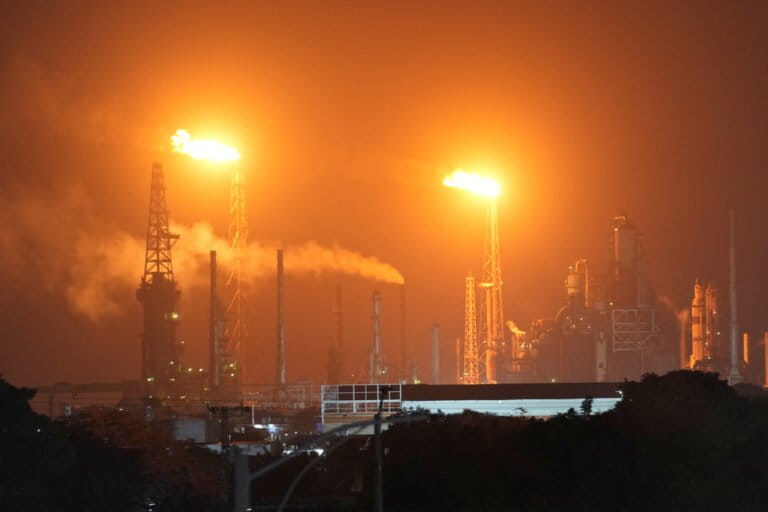
Flames rise from flare stacks at the Amuay refinery in Los Taques, Venezuela. (AP Photo/Matias Delacroix)
President Trump has signaled that he wants oil companies to begin producing in Venezuela as soon as possible. He proposed sending technical teams into the country to evaluate the industry, but the response from U.S. executives has been more cautious. In a meeting with President Trump this month, ExxonMobil CEO Darren Woods went so far as to call Venezuela “uninvestable,” citing weak regulations and security.
“If you’re an oil producer, you don’t throw oil away. Any leak or loss you try to fix as quickly as possible,” the same activist, who wished to remain anonymous due to security concerns, told Mongabay. “In Venezuela, that doesn’t exist. Oil spills are continuous and leaks are constant.”
Some observers say it will take years to repair Venezuela’s infrastructure to the point that outside investment becomes viable. When that happens, Venezuela’s laws governing extraction are relatively strong on paper, but experts told Mongabay they will need updating and real enforcement.
Most proven reserves are located in the Orinoco Oil Belt, stretching over 50,000 square kilometers (19,300 square miles) across four states containing wetlands and grasslands. As oil production increases, infrastructure risks breaking, spilling, and emitting harmful gases into the air.
Even Latin American countries with relatively strong infrastructure and regulations have struggled with oil spills, albeit in forested areas. Between 2012 and 2022, there were more than 3,000 spills in the Amazon across Bolivia, Peru, Colombia and Ecuador, a Mongabay investigation found. At least 109 of them overlapped with protected areas.
“Every oil operation has environmental risk,” Klein said. “The issue is that you need to know how to manage that risk.”
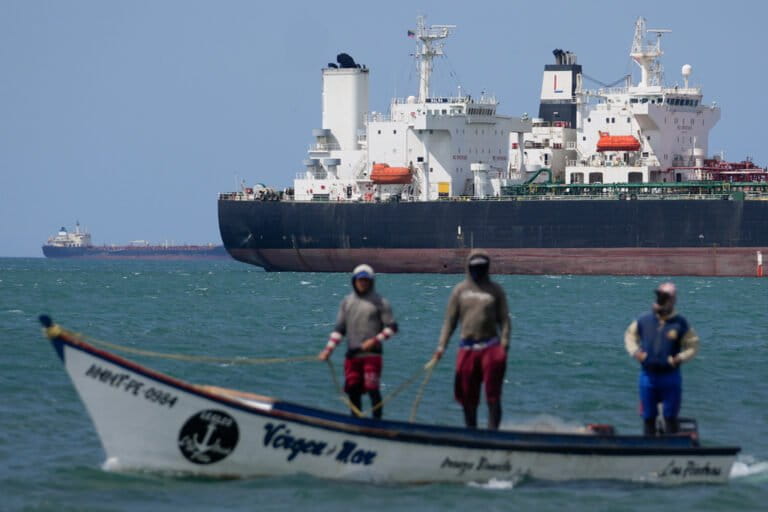
Fishermen pass an oil tanker in the Gulf of Venezuela off the shore of Punta Cardon, Venezuela. (AP Photo/Matias Delacroix)
Mining poses an even more complex problem. Extracting gold, coltan, cassiterite and other minerals requires introducing new infrastructure to fragile ecosystems. In addition to pumps, roads and heavy machinery, workers need places to sleep and buy food, and clinics for when they get sick or injured. Under the Maduro government, environmental oversight of these developments has been virtually nonexistent.
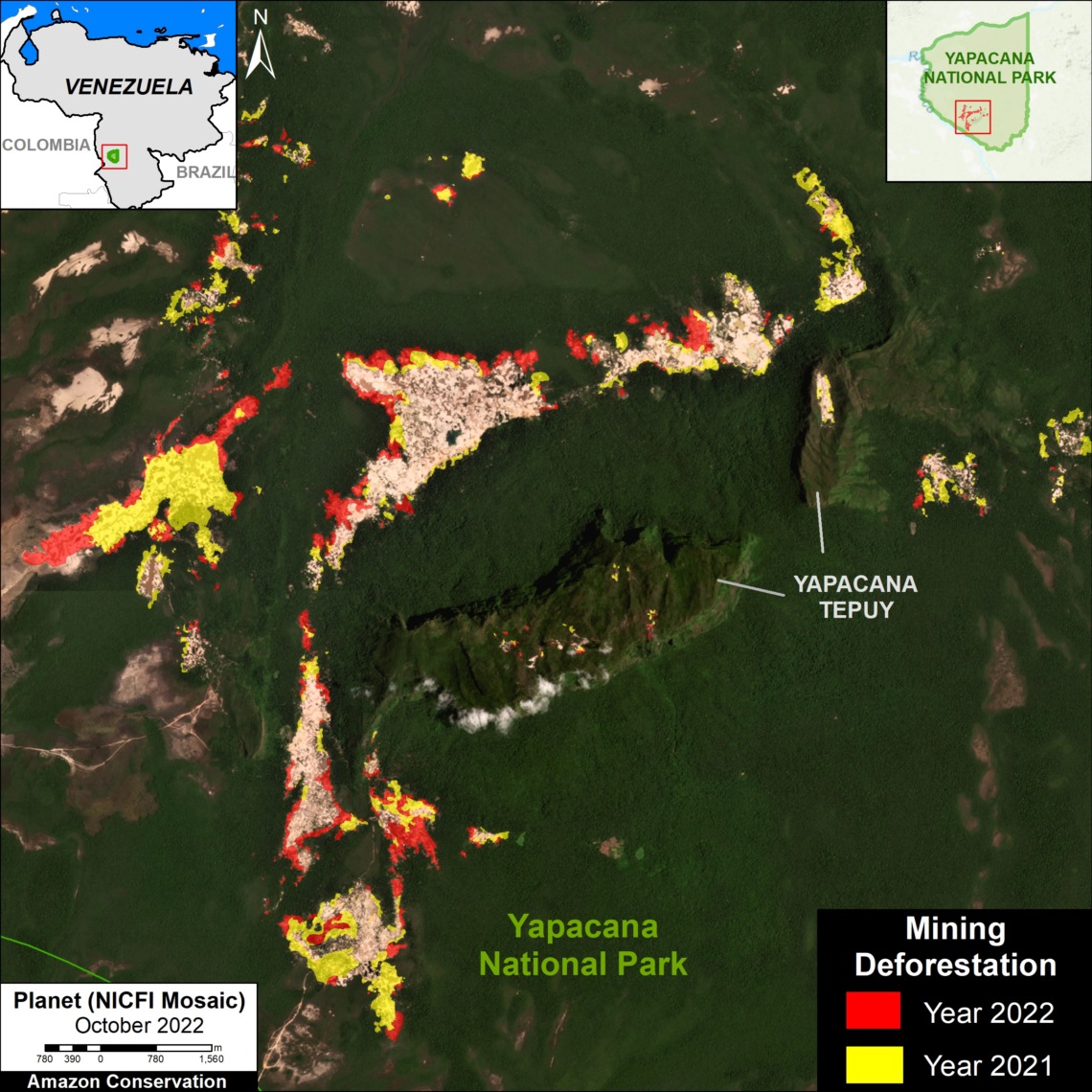
Satellite imagery has revealed illegal gold mining deforestation inside protected areas like Canaima National Park and Yapacana National Park, including on top of the Yapacana tepui, according to Amazon Conservation’s Monitoring of the Andes Amazon Project. The unique tabletop mountains are considered sacred by Indigenous communities.
In 2016, the government issued a decree creating the Orinoco Mining Arc, stretching over roughly 112,000 km2 (43,200 mi2) across three states with Amazon and savanna biomes. The decree and other existing laws establish all subsoil resources to be state-owned. In many cases, Venezuelan entities maintain a majority stake in mining operations run by foreign companies. Observers said those conditions would be unattractive to investors.
U.S. Secretary of Commerce Howard Lutnick told reporters that Venezuela’s mining industry, while having significant economic upside, had “gone rusty” and that President Trump was going to “fix it and bring it back.”
One of the largest challenges will be the presence of nonstate armed groups like the National Liberation Army (ELN) and dissidents of the Revolutionary Armed Forces of Colombia (FARC). These guerrilla groups control access to mine sites and routinely commit human rights violations in the area, including torturing and killing Indigenous people, according to a U.N. Human Rights Council investigation.
Companies will likely have to wait for the rule of law to be restored in these areas, observers told Mongabay. If they want to start working in the mining arc in its current state, they will have to coexist with organized crime — a situation that would likely exacerbate the violence.
“The ELN would definitely try to protect its mining interests, and they very much know how to conduct warfare from jungle terrain — also using local communities as a human shield,” said Bram Ebus, an International Crisis Group consultant and founder of Amazon Underworld, an investigative journalism project.
Ebus said a more plausible option for companies could involve working further down the supply chain, purchasing minerals from state mining operations. That would be equally concerning, he said, because they could more easily ignore environmental destruction and human rights violations.
Other observers say there’s still a responsible future for foreign companies in Venezuela, given its long history of conservation. The country created Latin America’s first environment ministry in 1976 and established a large network of protected areas. Even today, nearly half of Venezuelan territory is under some version of protection, though often only on paper.
“There was an incredible track record of conservation,” said Cristina Burelli, founder of SOS Orinoco, an advocacy group studying the mining conflict. “Venezuela was ahead of its time with regard to caring for the environment, conservation, caring for Indigenous people.”
Members of the opposition in Venezuela have expressed interest in returning to an era that respects the country’s natural resources and invests in renewable energy. Right now, the same government, under Maduro’s former deputy, Delcy Rodríguez, controls the country, so it’s unclear if or when the goals of the opposition could take hold.
“I’m very hopeful that Venezuela can, again, become a beacon of conservation and show the rest of Latin America how it should be done,” Burelli said.
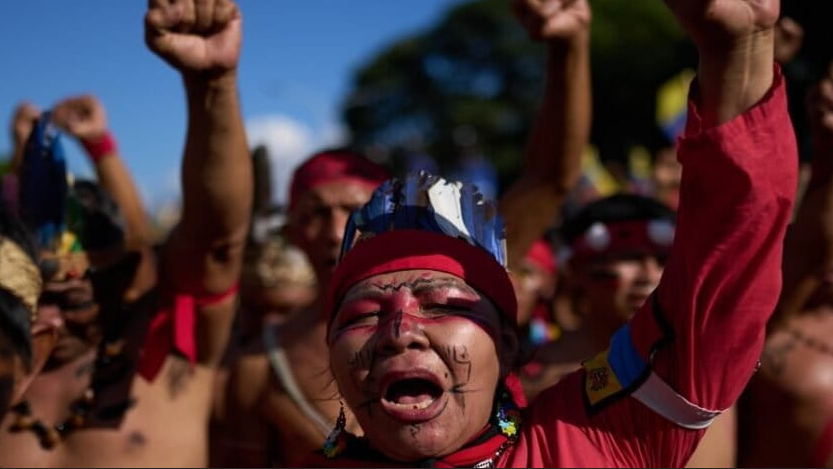
Banner image: People take part in an event on Indigenous Day in Caracas, Venezuela. (AP Photo/Ariana Cubillos)
Source : mongabay.com

The best of Tired Earth delivered to your inbox
Sign up for more inspiring photos, stories, and special offers from Tired Earth
By signing up for this email, you are agreeing to news, offers, and information from Tired Earth. Click here to visit our Privacy Policy.

Comment
Reply