


31 Oct 2026

Tired Earth
By The Editorial Board
After two weeks of marathon negotiations in Yerevan, nearly 200 countries adopted a compromise that relaunches momentum for the global biodiversity framework. But questions of financing, harmful subsidies, and recognition of Indigenous peoples' rights remain largely unresolved
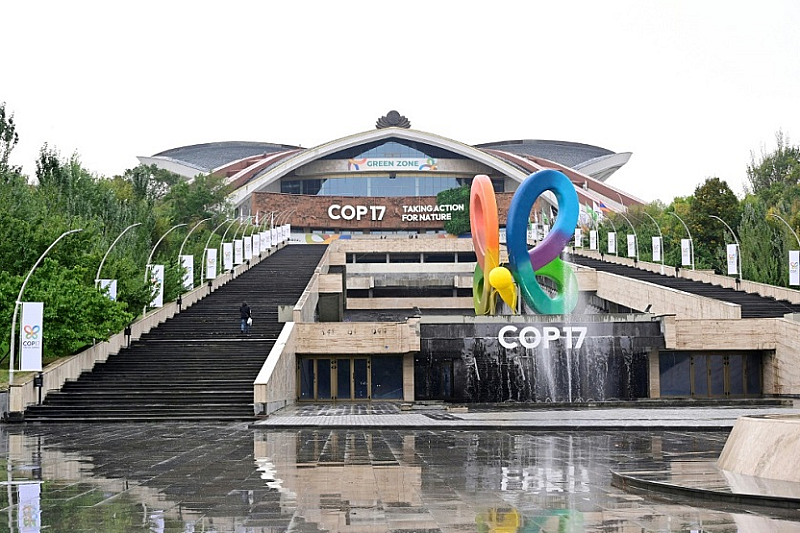
Applause erupted in the hall. On Saturday, October 31, COP17 President and Armenian Environment Minister Hambardzum Matevosyan brought down his gavel, sealing the adoption of key decisions on the first global review of biodiversity progress and on resource mobilization. "And there we have it. Perfect," he declared, to the relief of negotiators exhausted after two weeks of difficult talks.
Around 70 ministers joined the final week of negotiations to try to unblock the sticking points. COP17, which opened on October 19, was due to end on October 30, but debates ran through to Saturday.
An Unsparing Global Review
One of COP17's major achievements is the first global review of progress on biodiversity. Its verdict is severe: fewer than half of the national targets assessed are on track to be met, and progress toward most of the 23 global targets remains insufficient. Protected areas cover roughly 19% of land and inland waters, and 10% of marine areas—far short of the commitment to protect 30% of the planet by 2030.
The review is not a sanctions mechanism but a collective tool meant to help states course-correct. Its effectiveness will nonetheless depend on stronger national laws, conservation spending at the necessary scale, and genuine accountability.
The "Yerevan Pathway" to Accelerate Action
To close these gaps, discussions focused on the "Yerevan Pathway," a framework designed to accelerate action between 2026 and 2030. It prioritizes strengthening national strategies, improving monitoring, increasing financing, technology transfer, and capacity-building. It also emphasizes interministerial coordination and the meaningful participation of Indigenous peoples, local communities, women, and youth.
The underlying problem is that biodiversity protection often remains confined to environment ministries, while the decisions that affect forests, agriculture, fisheries, and infrastructure are made elsewhere within governments.
Financing: The Main Bone of Contention
This was the point that caused the most friction. The global framework aims to mobilize at least $200 billion per year from all sources by 2030, including $20 billion per year for developing countries as of 2025, and $30 billion by 2030. These targets do not date from Yerevan: they were set before COP17 and do not constitute new financial guarantees.
The annual biodiversity financing gap is estimated at around $700 billion, which gives a sense of the distance to be covered. Negotiators eventually found a compromise on resource mobilization, but it does not in itself guarantee substantial new funding.
On October 26, Germany, Iceland, Monaco, the Canadian province of Quebec, and the city of Berlin announced roughly $60.22 million in commitments to the Global Biodiversity Framework Fund. Germany made the largest pledge, with an additional €50 million, or about $56.1 million. These are, however, announcements, not confirmed disbursements.
Who Should Pay?
The negotiations revealed a persistent rift. The European Union argued for broadening the contributor base, contending that economically strong emerging countries should assume a larger share of financing. India, Brazil, and China opposed this, arguing that developed countries must honor existing commitments rather than transfer new responsibilities to developing economies. Saudi Arabia and the Gulf states also resisted any measure creating new financial obligations.
Harmful Subsidies: The Great Paradox
Another policy priority: reforming incentives that harm biodiversity. Target 18 of the global framework commits countries to eliminating, reducing, or reforming harmful subsidies, with a decrease of at least $500 billion per year by 2030. Yet according to figures cited in Yerevan, $2.4 trillion continues each year to feed nature-damaging subsidies that encourage deforestation, overfishing, pollution, and unsustainable agricultural practices.
The Armenian presidency launched three initiatives: the "Yerevan Call" on positive incentives, the "Friends of Target 18" group co-chaired by Finland and Colombia, and the "Yerevan Biodiversity Finance Challenge," with an initial envelope of $2 million supported by Germany. These platforms remain voluntary, and their effectiveness will depend on national budget decisions.
The Cali Fund and the Failure of Corporate Contributions
The Cali Fund, created to share the benefits of commercial exploitation of digital sequence information (DSI) on genetic resources, was sharply criticized for the weakness of corporate contributions. As of October 26, deposits amounted to just $8,990. Five companies had joined the mechanism by October 29, but substantial contributions from major corporations remained limited. The central difficulty is ensuring that companies profiting from nature's genetic information contribute fairly.
Science as a Point of Friction
The final negotiations also stumbled over how COP17 decisions should refer to assessments by the Intergovernmental Science-Policy Platform on Biodiversity and Ecosystem Services (IPBES). According to AFP, a French delegate accused Saudi Arabia, Russia, Argentina, and Brazil of blocking negotiations on these references. The debate centered in particular on whether governments should "welcome" scientific conclusions or merely "take note" of them—a distinction with major consequences in UN negotiations. These accusations reflect the viewpoint of negotiators involved, not a formal conclusion.
And Bangladesh?
Bangladesh, facing significant biodiversity loss and climate pressures, has updated its national strategy to align with the Kunming-Montreal framework, with 23 national targets covering 107 activities. The country estimates that implementing its goals will require approximately $3.3 billion and calls for predictable international financing, simplified access to grants, and capacity-building. Its priorities include protecting the Sundarbans, freshwater wetlands, rivers, coastal ecosystems, and threatened wildlife.
The Real Test Begins Now
The Yerevan agreements demonstrate that international cooperation remains possible despite deep divisions. They also show that countries can advance on one front while resisting on another—which makes any binary reading, supporters versus opponents of biodiversity, largely inoperative.
COP18 will be held in Quito, Ecuador, in 2028, following a close vote (55 to 53 over Panama). Until then, biodiversity continues to decline, harmful subsidies persist, and most global targets remain behind schedule. The success of COP17 will not be measured in declarations or diplomatic announcements, but in the forests, wetlands, wildlife, and communities that governments actually protect.
As one participant summed it up while leaving Yerevan: the real test begins at home.

The best of Tired Earth delivered to your inbox
Sign up for more inspiring photos, stories, and special offers from Tired Earth
By signing up for this email, you are agreeing to news, offers, and information from Tired Earth. Click here to visit our Privacy Policy.




Comment