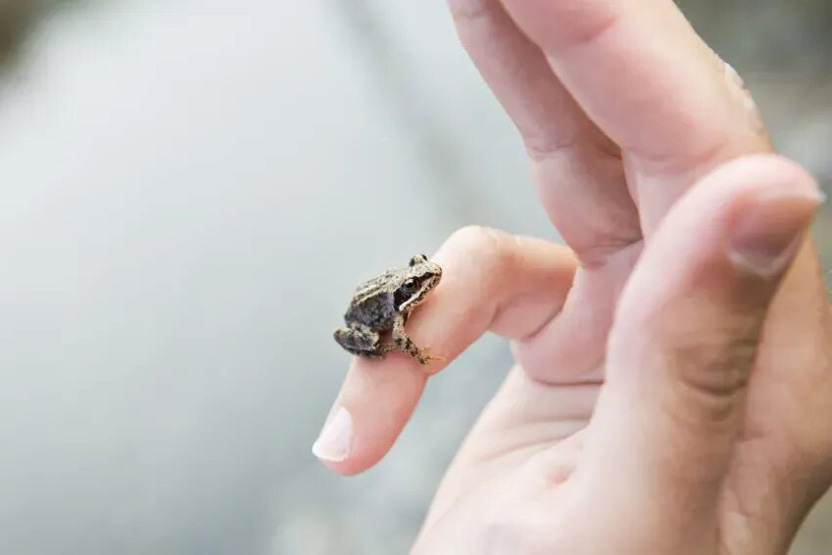
Early exposure to nature might help prevent biophobia. Credit: Anna Persson
Nature is a source of well-being and recovery for many people. However, research shows that there is also a growing number of individuals who experience negative emotions, such as fear, discomfort, or even disgust, toward nature. The phenomenon, called biophobia, is now highlighted in a new study from Lund University.
"Research has long assumed that people fundamentally feel positive emotions toward nature. We have examined the opposite, that is, when there is a negative relationship with nature, and gathered knowledge about how it arises, what consequences it has, and how it can be reversed," says Johan Kjellberg Jensen, researcher at Lund University and lead author of the study.
The study, published in Frontiers in Ecology and the Environment, summarizes nearly 200 scientific articles from various research fields and is a systematic review. Research findings from around the world, including studies carried out in Sweden, Japan, and the US, have been compiled to provide a full picture of biophobia.
Deteriorating relationship
The results show that negative emotions are shaped by both external factors, such as our surroundings, exposure to nature, and media narratives, and internal factors, including health and emotional traits.
The researchers also see signs that our relationships with animals, plants, and nature more broadly, is deteriorating over time. According to Kjellberg Jensen, a lack of contact with nature and limited knowledge about nature can reinforce each other in a negative spiral.
"Urbanization combined with parents' attitudes can increase negative feelings and perceived danger in nature among children—something which becomes particularly relevant as more and more children grow up in cities," says Kjellberg Jensen.
According to Jensen, contact with nature has well-documented health benefits. For example, reducing stress and improving school performance in children. The study shows that negative emotions can cause people to miss out on nature's health benefits and also contribute to attitudes and behaviors that run counter to conservation and sustainability efforts. This may include an aversion to species that are, in fact, harmless or even beneficial to have in our proximity.
Reversing the trend
Kjellberg Jensen hopes the overview will give biophobia a clearer position in research and contribute to solutions. He argues that an important step is increasing our exposure to nature, for example, by developing green spaces and strengthening biodiversity in cities, which can provide children with positive experiences with nature early in life.
"The phenomenon of biophobia is broad and requires a diverse toolkit. In some cases, it is about increasing knowledge and contact with nature; in others, it could be about reducing points of conflict between humans and nature. We need to understand the mechanisms behind the negative emotions better to reverse the trend," Kjellberg Jensen concludes.
Provided by Lund University











Comment