



30 Dec 2025

Tired Earth
By The Editorial Board
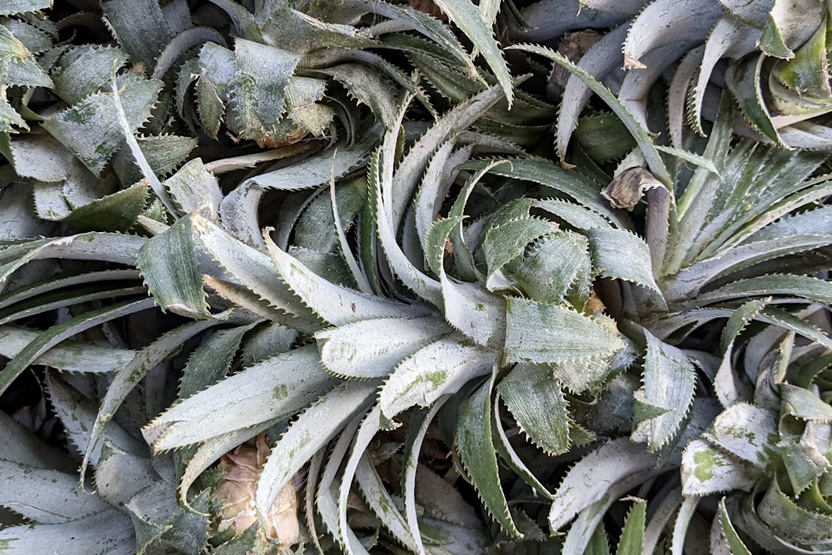
Pineapple leaves are thrown away but can now be used to clean up toxic metals and take fingerprints. Mauled/Shutterstock
In South Africa, manufacturers of pineapple juice and other pineapple products discard thousands of tons of pineapple leaves every year, with most ending up in dumpsites.
The leaves are seen as agricultural waste and usually treated as useless. However, they can be converted into something that solves real-world problems. Pineapple leaves can be turned into a powerful resource for both environmental protection and security.
This involves turning them into a special kind of nanoparticle. (Nanoparticles are very tiny materials, no bigger than 0.0001 millimetres.)
I’m part of a team of nanomaterial chemists who focus on the fabrication of new materials from waste like pineapple leaves. We set out to discover if we could turn pineapple leaves into a nanoparticle powder that would adsorb (to hold a substance on the surface of a material, forming a thin film) copper, or Cu²⁺, from wastewater. We found that it could. Once the pineapple leaf-based nanoparticles had adsorbed the copper, they could be ground into a powder that forensic investigators can use to dust for invisible fingerprints.
Our research filled a gap. It is the first time that an agricultural waste-derived adsorbent made into nanoparticles has been used to soak up heavy metals from water – and then reused afterwards in forensic science, at a low cost.
A bonus is that pineapple leaves cost nothing. While some are being turned into disposable diapers, and others are left on pineapple fields to compost, most are thrown away on landfills or even burnt on site. Transforming the waste into a useful product supports the idea of a circular economy: keeping products in use by reusing and regenerating them as much as possible.
Products that clean up the environment and those used in forensic science have traditionally been researched separately. Developing one product that can do both at a low cost is important. Effective and sustainable ways to remove toxic heavy metals from water sources are vital to protect human health and ecosystems, and finding improved ways to uncover invisible fingerprints is crucial in combating crime.
Why society needs the power of pineapple leaves
Wastewater contains toxic copper ions that flows into it from industries such as mining, electroplating, and manufacturing.
Copper pollution is a well-known problem in South Africa. Sludge often contains very high amounts of copper, and industrial wastewater can also contain copper that is higher than safe limits. Too much copper can harm people’s health, causing stomach problems and damage to the liver and kidneys over time. It’s also dangerous for aquatic life – fish and other species can be poisoned by it.
Most adsorbents are expensive when deployed to clean up wastewater that’s been contaminated by heavy metals like copper. Another hidden cost is that this contaminated water can’t be used again in industry or agriculture, until the copper has been removed.
Society is also affected. Polluted water sources undermine public trust in water safety, can trigger community health crises, and use up scarce public funds for cleanups. So a cheap adsorbent really helps.
Police and other forensic investigators also need the power of pineapples. They currently use fingerprint powder that contains chemicals which pose potential health risks to the people handling them. A material derived from pineapple leaves provides a safer, more sustainable, and eco-friendly alternative. The novelty here is the fabrication of a cheap powder from biomass waste.
How we made this discovery
We first coated carbon nanoparticles made from pineapple leaves with zinc oxide. Then we checked how well the nanoparticles could remove copper from water.
Our research found that pineapple-leaf based nanoparticles coated with metal oxide (in this case zinc oxide) form a material that sucks up copper in large quantities.
The reason the pineapple leaf nanoparticles work so well is because of how their parts work together. The zinc oxide (ZnO) coating and the sponge-like carbon structure make a great team. The coating helps the particles grab onto other materials more easily, while the porous (hole-filled) carbon gives them lots of surface area to react on.
Together, they create more spots where chemical reactions can happen and help the materials stick together more strongly, which boosts their overall performance.
We then tried to see if there was a further use for the spent adsorbent (the nanoparticles that were full of the copper they’d adsorbed). We powderised these nanoparticles and spread them over a porous surface. We found that the powder showed up clear ridge patterns and could be used to dust for latent fingerprints (invisible fingerprints left by people’s natural oil and sweat).
What needs to happen next
Our study suggests that there is strong potential for scaling up this technology in water treatment facilities and forensic laboratories.
To start this off, research institutions and universities should test the performance of these nanoparticles in municipal or industrial wastewater treatment plants. Longer tests would also show whether the pineapple leaf nanoparticles are cost effective over the long term.
The nanoparticles also need to be tested to see whether they remain stable for a long time in water and don’t break down.
Forensic laboratories and law enforcement agencies should explore ways of including the spent adsorbent into their work in uncovering invisible fingerprints. Using the spent adsorbent instead of ordinary fingerprint powders could reduce costs.
Government bodies and policymakers should support this new discovery through funding and incentives for sustainable, multifunctional materials.
Nanoparticles that enhance agricultural waste and address both environmental and societal needs should be prioritised for development.
At some point, regulations will also be needed.
Industry partners, particularly those in agricultural processing, mining and manufacturing, can play a role by supplying crop waste and coming up with ways to commercialise the products.
By fostering collaboration between academia, industry, government and law enforcement, this technology can help address heavy metal pollution. It could also reduce waste, and spur the creation of new pineapple leaf products.
Source : theConversation

The best of Tired Earth delivered to your inbox
Sign up for more inspiring photos, stories, and special offers from Tired Earth
By signing up for this email, you are agreeing to news, offers, and information from Tired Earth. Click here to visit our Privacy Policy.




Comment