



25 Feb 2026

Tired Earth
By The Editorial Board
Solar flares have long been known for their ability to disrupt Earth's upper atmosphere and spark auroras. However, a new study proposes a more unconventional theory: What if these solar explosions, even if subtly, play a role in triggering some earthquakes?
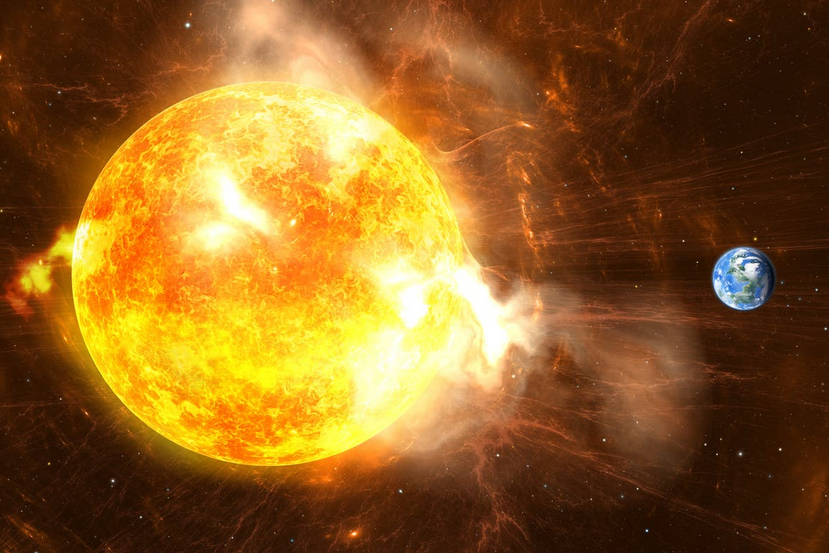
A research published in the International Journal of Plasma and Environmental Technology, suggests an indirect electrical connection between the Sun and Earth's faults.
The hypothesis is based on the effect of solar flares on Earth's ionosphere, a charged region about 400 kilometers above the surface, where auroras are created by the interaction between charged particles from the Sun and the Earth's atmospheric elements.
Researchers conceptualize Earth as a vast electrical system, with superheated and pressurized ion-rich fluids accumulating in the deep cracks of Earth's crust, where tectonic stress is stored. According to their model, these areas could behave like an "electrical capacitor," storing energy.
When a solar flare directed at Earth occurs, it alters the electron density in the ionosphere, causing charge to flow toward lower layers and creating a negatively charged region. Theoretically, this boosts the electric field extending toward the Earth's crust, slightly changing the pressure acting on tectonic faults.
The study’s authors suggest that these changes could, in some cases, be enough to "push" a weak fault to slip, much like how tidal forces or atmospheric pressure variations can impact fault stability.
Japan's 2024 Noto Peninsula Earthquake: A Possible Clue?
The researchers pointed to the 2024 earthquake in Japan’s Noto Peninsula, which coincided with intense solar activity, as a potential supporting case for their theory. However, the correlation remains statistical and inconclusive.
Scientific bodies, such as the U.S. Geological Survey, have long stated that earthquakes do not exhibit a clear periodic pattern that matches the 11-year solar cycle (with the peak of Solar Cycle 25 expected by the end of 2024). Both solar flares and earthquakes are relatively frequent events, so the possibility of their coincidental timing remains.
_1771997834.png)
Image of the aftermath of Japan's 2024 Noto Peninsula Earthquake
Criticism and Skepticism
Several geophysicists have criticized the model used in the study, arguing that it oversimplifies the complexities of Earth's crust and its multiple layers, which resist electrical conductivity. Critics also contend that deep rocks could weaken the electric field before it could have any significant impact on fault stability.
Moreover, some researchers point out that the lack of direct observational evidence limits the strength of the hypothesis, reinforcing the well-known scientific principle: "correlation does not imply causation."
A Door Still Open for Exploration
Despite the debate, the door remains slightly open for the theory. The relationship between “space weather” and Earth systems is still an emerging field of research. More precise measurement tools in the future might reveal subtle effects that have previously gone undetected. Until then, the hypothesis remains intriguing, though unproven.

The best of Tired Earth delivered to your inbox
Sign up for more inspiring photos, stories, and special offers from Tired Earth
By signing up for this email, you are agreeing to news, offers, and information from Tired Earth. Click here to visit our Privacy Policy.





Comment
Reply