



27 Apr 2026

Malec Paoli-Devictor
Environmental analyst and journalist
While SIPRI reports confirm a tenth consecutive year of growth in global military spending, reaching a historic peak in 2025, environmental ambitions are losing momentum. Between the financing of a "war economy" and the sidelining of climate issues at diplomatic summits, the budgetary choices of major powers now appear to favor armed sovereignty over the ecological transition.
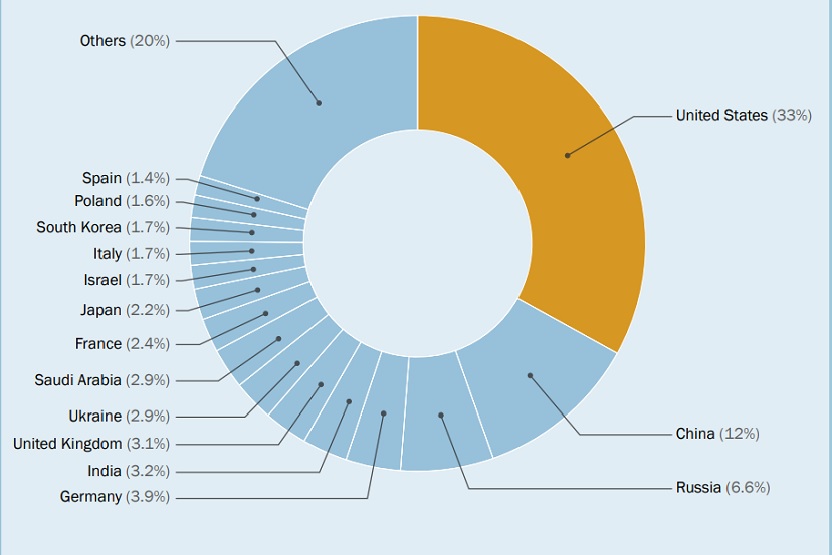
The share of world military expenditure of the 15 countries with the highest spending in 2025 (SIPRI)
A Historic Record: $2,887 Billion for Armament
The year 2025 marked an unprecedented turning point in the arms race. According to data reported by Le Figaro, global military spending surged to a staggering $2,887 billion.
This progression, representing the sharpest annual increase since 2009, is driven by a volatile geopolitical landscape. As 20 Minutes highlights, this dynamic is fueled by "Russia's invasion of Ukraine and growing tensions in East Asia."
Drivers of the Surge: Europe and Asia at the Forefront
The rearmament is particularly dramatic across the European continent. Le Monde specifies that European countries recorded the most massive increases as they seek to strengthen defense capabilities against the Russian threat.
United States: Remains in the lead with $961 billion (33% of the world total).
China: The world's second-largest budget, with an estimated 6% increase.
France: Ranks 9th globally with $63.5 billion but is being outpaced by its European neighbors. BFM TV notes that Germany (7th) and the United Kingdom (6th) now have significantly larger budgets, each exceeding $80 billion.
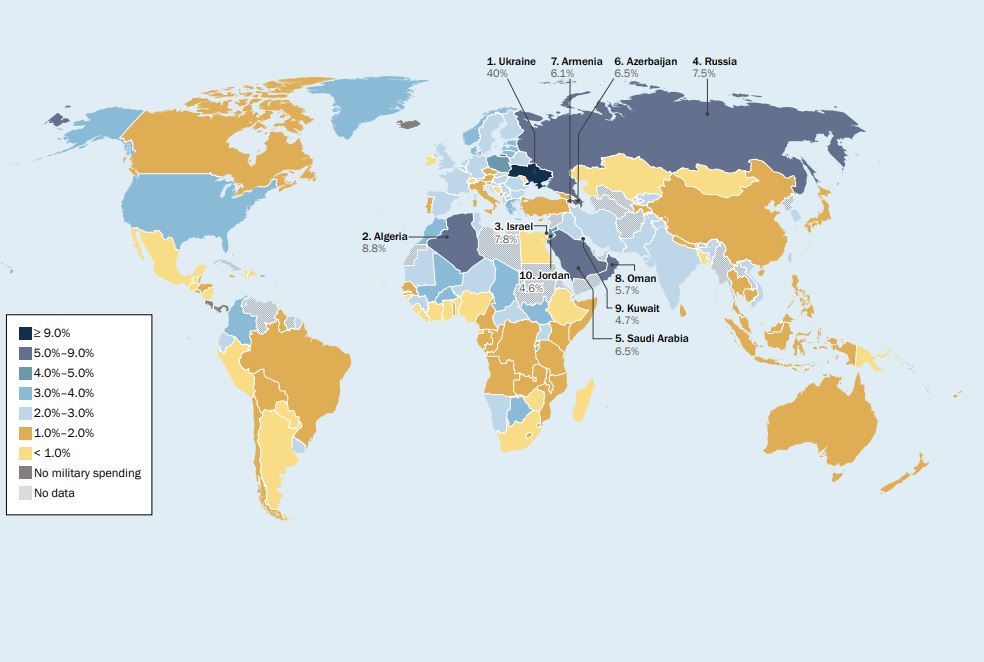
Military spending as a share of gross domestic product, by country, 2025 (SIPRI)
Sustainable Finance at the Service of "Sovereignty"
This shift in capital does not only concern state budgets. The financial sector is also undergoing a semantic and strategic transformation. According to an analysis by Les Echos, sustainable finance—initially centered on Environmental, Social, and Governance (ESG) criteria—is now integrating the concept of sovereignty.
Under government pressure, investments in the defense industry are increasingly perceived as "social" or "ethical" because they guarantee the security of democracies. This shift raises fears of a scarcity of capital available for decarbonization projects, as priority is now given to immediate military and energy independence.
Climate: The Great Loser of Diplomatic Arbitrations
While arsenals are being filled, climate ambition is withering on the international stage. An alarming signal came from the latest G7 summit: Euractiv reveals that environmental issues were "sidelined from the agenda" to avoid upsetting the United States and to prioritize discussions on collective security and trade.
A Crucial Need for Funding
This deprioritization comes at a time when the needs for the transition have never been more urgent. The Climate Action Network (Réseau Action Climat) reiterates that it is imperative to "finance a just ecological transition" to prevent an increase in inequalities. The Climate Action Network argues that without a massive redirection of public and private financial flows toward climate action, the goals of the Paris Agreement will remain structurally out of reach. They emphasize that current investments are "largely insufficient" to meet the scale of the crisis.
Conclusion: A Perilous Imbalance
The contrast is striking: on one hand, a nearly limitless financial mobilization capacity for armament (over $2,800 billion); on the other, climate negotiations that stall over a few dozen billion for the Loss and Damage fund. In 2026, "security" seems to be defined by weaponry, overshadowing the fact that climate instability could eventually become the primary threat to world peace.

The best of Tired Earth delivered to your inbox
Sign up for more inspiring photos, stories, and special offers from Tired Earth
By signing up for this email, you are agreeing to news, offers, and information from Tired Earth. Click here to visit our Privacy Policy.



Comment
Reply