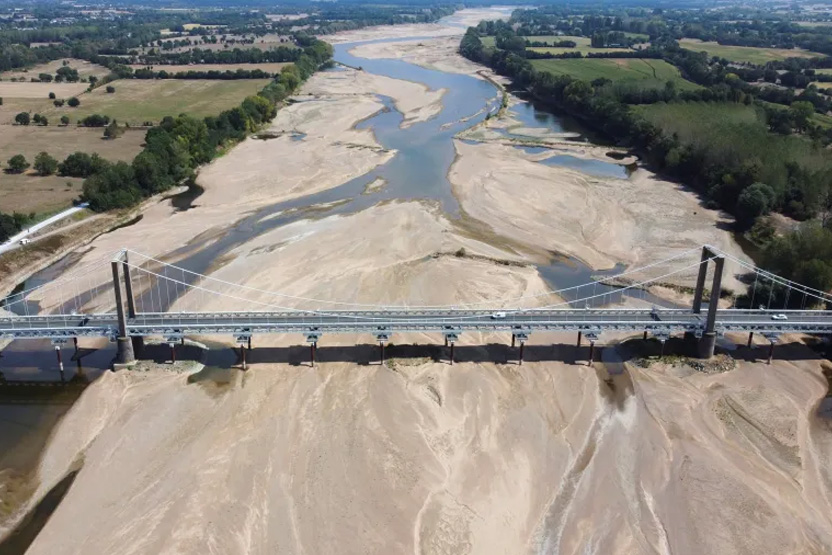
The Loire River in France is grappling with an unprecedented drought.
Europe’s already-parched summers may become dramatically harsher and longer if the Atlantic Meridional Overturning Circulation (AMOC) collapses, according to a new study warning of consequences that could persist for centuries.
The AMOC — a vast oceanic “conveyor belt” that carries heat from the Southern to the Northern Hemisphere — plays a critical role in stabilising global climate patterns. Scientists have long cautioned that human-driven climate change is weakening this system and could push it past a point of no return.
This study is the first to examine what Europe’s summer rainfall would look like under different climate scenarios if the AMOC were to fail.
A turning point with severe climate consequences
Lead author René van Westen, a postdoctoral researcher in marine and atmospheric sciences at Utrecht University, said the AMOC effectively “shapes the entire global climate system.” Its influence explains why north-west Europe enjoys relatively mild weather compared with southern Canada, despite lying at similar latitudes.
If the circulation collapses, winter temperatures across Europe would fall sharply, while summers would become significantly drier.
Using eight climate simulations spanning more than a thousand years, the researchers explored scenarios involving both pre-industrial greenhouse gas levels and future emission pathways. In moderate-emission scenarios (RCP 4.5), a large influx of freshwater — such as from melting ice sheets — altered Atlantic salinity enough to trigger an AMOC collapse. Smaller inflows allowed partial recovery. Under the high-emissions pathway (RCP 8.5), increased freshwater input consistently led to a full breakdown.
A future of harsher summers
In a warming climate, evaporation rises and dries out soils — a trend that intensifies sharply if the AMOC collapses.
Across Europe, the severity of summer drought — measured as the gap between water lost to evaporation and water gained from rainfall — would increase by 8% under a moderate-emissions scenario with an intact AMOC. If the AMOC fails, the increase jumps to 28%.
The impacts would be uneven. Northern Europe would face particularly stark shifts: Sweden, for example, would see drought severity rise 54% with a functioning AMOC and 72% without it. Southern Europe would also suffer. Spain, already struggling with prolonged drought, would face a 40% increase with the AMOC intact and 60% if it collapses.
Climate scientist Karsten Haustein of Leipzig University cautioned that the next 50 to 100 years of projected drying do not necessarily reflect Europe’s longer-term climate. But Stefan Rahmstorf of the Potsdam Institute for Climate Impact Research warned that the AMOC is weakening significantly and that any collapse would lock Europe into consequences lasting at least a millennium — a “huge responsibility” for today’s policymakers.
Europe warming faster than any other continent
Europe is warming at 0.53°C per decade — the fastest rate of any continent — with the summer of 2024 marking record-breaking heatwaves. Studies suggest European summers will continue to lengthen dramatically, with more than a full extra month of summer days projected by 2100 under greenhouse-gas-driven warming.
With or without an AMOC collapse, scientists agree that climate-driven drought will intensify — but the breakdown of the Atlantic circulation would push Europe into a far more extreme and long-lasting climate regime.








Comment
Reply